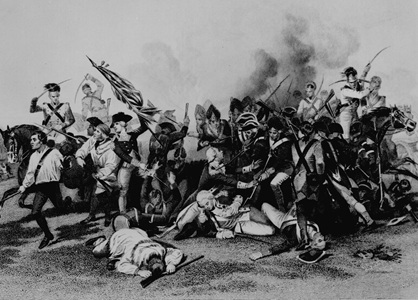
Battle of Camden. Engraving from painting by Alonzo Chappel. Credit: Alonzo Chappel/National Archives and Records Administration
His name was John Pumphrey.
At a small gathering of his relatives in Baltimore today, in the shadow of his boyhood home, FHD Forensics revealed the story of a young fallen Revolutionary War soldier. More than 240 years after the Maryland teen died on a bloody South Carolina battlefield, a tiny piece of his skull was used to extract his DNA and uncover his identity.
In 2022, skeletal remains and artifacts of 14 Revolutionary War soldiers from the Battle of Camden were unearthed after shallow battlefield burials were being exposed by many years of erosion and relic hunting activity.
Now known as the “Camden Fourteen,” John Pumphrey is the first to be identified of the group.
Advanced DNA and persistent work
Pumphrey’s remains were unearthed in 2022—along with 13 others—when South Carolina Institute of Archaeology and Anthropology (SCIAA) rescued shallow battlefield burials from erosion and relic hunting. After a lavish military funeral, they were reburied in 2024.
According to biological anthropologists Drs. Madeline Atwell and William Stevens of the Richland County Coroner’s office, Pumphrey was just 13 to 15 years old when he enlisted in Maryland’s 7th Regiment in Baltimore in 1777. He would have been one of the youngest members of George Washington’s revered “Old Line.”
Astrea Forensics extracted and sequenced the DNA that empowered FHD’s analysis.
After uploading the genetic profile to databases that allow this kind of matching, the FHD team quickly identified his ancestors—all from prominent founding families of Anne Arundel County. Genealogists asked themselves why a young boy from a prosperous family would have chosen to go to war. Eventually a picture emerged: Army pay, new clothes, and meals would have been life changing for an orphaned middle son.
“When we started this journey in 2023, we had no idea if it would even be possible to identify someone whose living genetic relatives would be so many generations distant,” said FHD senior genetic genealogist Valerie Kemp.
But, Kemp uncovered the critical X Chromosome connections to John Pumphrey’s mother that made the whole picture come together.
Three different types of DNA matching were required to make the identification that many believed impossible.
“There are so many interesting chapters of history that can now be known more fully. Especially in the fog of war, where the sacrifices that were made couldn’t always be documented,” said Richard Green, Astrea’s co-founder.
In a full circle development, just a few yards away in the very same burial ground with John Pumphrey, lies another very special man. That man’s YDNA, passed down to his own son, helped to confirm our hero’s identity.
In a stunning twist of fate, this man’s paternal ancestor was the family villain whose actions surely led to John Pumphrey dying in battle at such a young age. To understand that bombshell requires reading the biography that Peacock published on her Family History Detectives blog.
[Editor’s note: the story is absolutely worth the read if you have some time!]
A unique 240-year-old situation
Peacock says it truly took a village to pull off the groundbreaking case, thought to be one of the oldest John Doe genetic genealogy identifications ever.
“It’s incredibly expensive work and it was the ultimate group effort to make the dream we were chasing a reality,” she said. “At times everyone on the team worked pro bono. We don’t give up on identification cases.”
SCIAA’s lengthy dedication to the Camden Battlefield laid the groundwork for the endeavor. They also helped fund the genetic profiles. Additional sponsorship came from the South Carolina Battleground Preservation Trust (SCBPT), Historic Camden Foundation, Genealogy For Justice, and the DNA project’s participants and fans.
While relatives frequently contribute DNA or cooperate with investigators, Peacock verified that John Pumphrey’s relatives helping to finance the final expenses for his identification was truly unique in unidentified remains cases.
The investigation also received generous support from FamilyTreeDNA, who facilitated a research upload of Pumphrey’s data to their database of users who had opted in to this kind of comparison.
“FTDNA’s unique YDNA services were crucial to our success at confirming this soldier’s surname,” said Cyndi Despault, FHD’s operations manager, who was in charge of reference DNA testing.
As SCBPT’s executive director, Rick Wise told the relatives in attendance, “We are proud that identifying this soldier allows you, his family, to know the fate of their relative and that his sacrifice is being honored by a grateful nation.”
Wise also pointed out that Private Pumphrey represents about 400 others—including over 330 Continentals—who fell on the Camden Battlefield that day making it a hallowed ground filled with shallow, unmarked graves.
John Pumphrey now rests in Camden’s historical Quaker Cemetery not far from the battlefield. Peacock thinks John’s Quaker grandfather, Ebenezer Pumphrey would have surely approved of his grandson’s final resting place.
FHD Forensics joins with the entire cohort of collaborators on this project to thank the Secretary of the Army and the Executive Director of the Office of Army Cemeteries and Army National Military Cemeteries, Karen Durham-Aguilera, for expert advice and stewardship of this project honoring America’s first veterans.
Republished courtesy of FHD Forensics