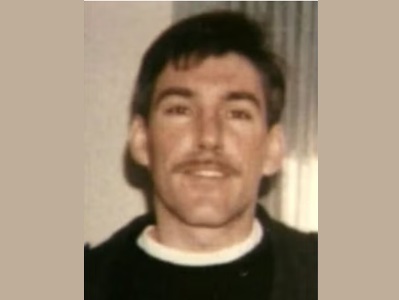
Roger Goodlet. Credit: Hamilton County Coroner's Office
Alleged serial killer Herb Baumeister is suspected of murdering over a dozen men in the early-to-mid 1990s in central Indiana. In fact, in June 1996, police found the remains of 11 men on Baumeister's property—as well as an additional 10,000 bones and bone fragments.
Now, DNA has confirmed the identity of one of those victims, likely the first one buried on Baumeister's property at Fox Hollow Farm.
Advanced DNA analysis done at the University of North Texas Center for Human Identification has confirmed the identity of Roger Goodlet. This DNA confirmation supports an identification initially made in 1996 through dental records.
The police were first tipped off to Baumeister’s murder spree in 1994 by Tony Harris, a friend of Goodlet’s. Harris told the police a gay bar patron calling himself “Brian Smart” hd likely killed Goodlet. Harris’ suspicion was based on his own encounter with “Smart,” who had attempted to kill him with a pool hose after they met at a gay bar. Harris eventually saw this man again in August 1995, following his car and noting his license plate number.
The police were then able to identify “Brian Smart” as Herb Baumeister. When police asked to search his house as a suspect in the disappearance of Goodlet, Baumeister and his wife refused. However, by June 1996, an increasingly frightened Julie Baumeister filed for divorce and consented to a property search while Baumeister was out of town.
In addition to 10,000 bones and bone fragments, police found the remains of 11 men, although they said they believed at least 25 people were buried on the sprawling 18-acre farm.
With a warrant out for his arrest, Baumeister fled to Canada where he died by suicide. He left a note but did not admit to any crimes or mention any names of potential victims.
Police identified some of the 11 men rather quickly through dental records—including Goodlet. For the rest however, DNA testing was not funded at the time, stalling the investigation and any further identifications.
The reinvestigation
It was the family of a previously unknown presumed victim—Allen Livingston—who inspired Hamilton County Coroner Jeff Jellison to renew identification efforts for the unknown remains found at Fox Hollow Farms in 1996.
Livingston’s cousin reached out to Jellison hoping to provide Livingston’s ailing mother with some closure before her death. Livingston’s family long thought he was a suspected victim of Baumeister.
Delving into the cold case, Jellison sent 44 individual bones or fragments recovered from the Fox Hollow Farm property to the Indiana State Police Laboratory for analysis. In an incredible moment, Livingston’s remains were the first to be identified—about a year before Livingston’s mother died.
But Jellison couldn’t just walk away from the case after that, not after knowing how many more men are possible victims. Thus, the official reinvestigation was launched with the University of Indianapolis’ forensic archaeology laboratory, Indiana State Police, Othram, and other law enforcement partner agencies.
In April 2025, the Center for Human Identification at the University of North Texas Health Science Center signed on as a partner. The remains from at least five victims have been sent to CHI thus far—one of them now confirmed to be Goodlet, whose disappearance and murder started the initial investigation.