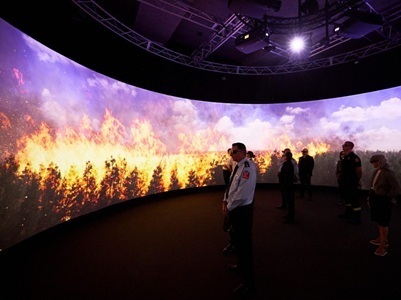
iFire immerses crews inside a dynamic fireground where they can interactively explore their responses. Credit: UNSW Sydney/Richard Freeman
Researchers from UNSW Sydney, in partnership with NSW fire agencies, have developed an immersive fire simulation system to help emergency responders build vital skills to tackle bushfires.
Firefighters are stepping into towering walls of flame, racing wind-driven fire fronts and navigating fast-moving bushfire emergencies, all before confronting the real thing.
Researchers at UNSW’s iCinema Research Centre have developed iFire 1.0, an AI-driven 3D visualisation system that immerses teams of firefighters and incident commanders in virtual fire grounds, enhancing their ability to anticipate and respond to real-world fire fronts.
The program was designed in collaboration with Fire and Rescue NSW (FRNSW). FRNSW Deputy Commissioner – Strategic Capability Paul McGuiggan and Commissioner of the NSW Rural Fire Service Trent Curtin visited UNSW to try out the new training program.
“The simulations help fire crews develop situational awareness and decision-making under pressure by engaging in high-risk scenarios in a controlled, yet realistic environment,” said Scientia Professor Dennis Del Favero, Director of the iCinema Centre, at UNSW Arts, Design & Architecture. “They can gain a firsthand sense of what extreme fires look and feel like, enabling stronger preparedness for their erratic and dangerous nature.”
The initiative is part of a five-year partnership between UNSW and Fire and Rescue NSW to integrate the system into training programs. The exercises are being delivered in a 3D immersive cinema at the FRNSW Emergency Training Academy at Orchard Hills in Sydney’s west, with plans to extend the technology to the Rural Fire Service volunteer brigade.
“It’s been a privilege to see first-hand how this unique, cutting-edge technology is progressing,” said FRNSW Deputy Commissioner – Strategic Capability Paul McGuiggan. “We first embraced this program in 2024 and are now seeing it develop further into an important tool to help our commanders make the right, life-saving strategic decisions, albeit in a safe virtual reality-based environment.”
NSW Rural Fire Service (RFS) Deputy Commissioner Peter McKechnie said emerging technologies could enhance how firefighters prepare for bushfires and other emergencies.
“Advances in technology are providing additional tools to support training, allowing firefighters to experience scenarios that help build skills and confidence for decision-making on the fireground. This has the ability to complement the hands-on experience and established operational training practices central to our capability," said McKechnie.
About the challenge and iFire response
Fire crews have faced significant challenges during the 2025-26 bushfire season in New South Wales. In early December, more than 75 bushfires burned across the state, destroying at least a dozen homes and prompting disaster recovery support across six local government areas.
Unlike traditional training burns or standard virtual reality drills, iFire immerses crews inside a dynamic fireground where they can interactively explore their responses. The iFire system uses simulation data developed by the CSIRO and is based on real fires that occurred in South Australia and Victoria in 2021 and 2023.
“iFire is unlike standard individualised VR drills,” Del Favero said. “Using our system, the crew feels physically present and can experience the fire from any perspective at any point in time, and interact with it as a team.”
The two training modules address real-world fire response. The first, designed for new recruits, focuses on situational awareness, including assessing fire danger, evaluating its spread, identifying hazards and planning evacuation routes.
The second module, tailored for incident commanders, addresses complex decision-making during multi-fire incidents. It covers organizing crews, establishing suppression points, advising residents and overseeing mop-up operations after the main fire is contained.
“It’s not just an individual experience. It allows crews to practise as a team,” said Del Favero. “When faced with real incidents, crews can draw on this experiential group training to better protect lives, animals and infrastructure.”
Future training modules
iFire 2.0 will integrate a deep-learning AI model that enables firefighters to select environmental variables, such as wind speed and direction, to create unanticipated fire scenarios and rehearse their responses. The aim is to prepare crews for the extreme fires that are now occurring under climate change.
“As climate change makes bushfires larger, hotter and more volatile, we can replicate those conditions within the simulation,” Del Favero said. “These dynamic encounters are invaluable in helping crews make better decisions and reduce risk when facing the uncertainty of extreme fires.”
UNSW Vice-Chancellor and President, Attila Brungs, said the collaboration underscored the power of researchers and emergency services working together.
“UNSW’s world-leading research is enhancing frontline bushfire readiness through the use of innovative technology,” Brungs said. “By strengthening the preparedness and skills of the firefighters who protect our lives and livelihoods, this partnership stands as a clear example of progress for all in action.”
Republished courtesy of UNSW