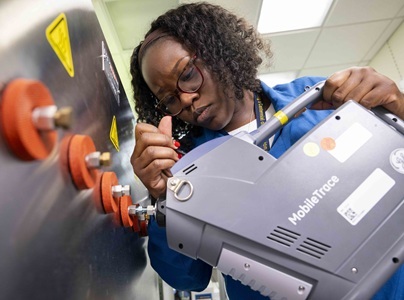
Ashley Fulton, Ph.D., U.S. Naval Research Laboratory research chemist, uses an ion mobility spectrometer to test a vapor generated from a trace explosive sensor testbed. Photo: U.S. Navy photo by Sarah Peterson
Forensic scientists have tapped into the power of silicon to create a handheld detector that can rapidly register trace amounts of fentanyl in a suspected sample to give first responders a better idea of what they are dealing with when responding to a scene.
Instead of looking for fentanyl itself in a sample, researchers targeted a chemical marker the potent synthetic drug gives off in air called N-phenylpropanamide (NPPA)—a tiny by-product molecule that forms as fentanyl breaks down and acts like a unique fingerprint.
The team of researchers from the Naval Research Laboratory and Florida International University’s Global Forensic and Justice Center used solid phase microextraction (SPME) to sample the N-phenylpropanamide, before bringing it to the lab for analysis by gas chromatography–mass spectrometry (GC-MS). The results showed that NPPA is a reliable vapor signal for fentanyl and its close relatives.
The researchers then fine-tuned a portable ion mobility spectrometer (IMS), a handheld detector that measures how charged particles move through gas, so it could recognize the NPPA signal at amounts as small as five nanograms without being tricked by common drug fillers such as mannitol, lactose, or acetaminophen.
To further enhance sensitivity, the team integrated a silicon nanowire preconcentration array coated with an acrylate-based polymer. This configuration increased NPPA detection up to 14-fold in laboratory testing and maintained performance even in the presence of street-level adulterants. The silicon nanowire device is critical as it absorbs target vapors and then releases them as a concentrated pulse.
The portability of the ion mobility spectrometer was key to this work as in-field detection of adulterants remains difficult since so much of detection technology requires in-laboratory spectrometry. The same is true of the silicon nanowire array—in-laboratory spectrometry is highly sensitive, whereas some of that can be lost when the technology goes mobile. In this instance, the array was able to recoup some of that lost sensitivity to ensure detection at previously undetectable trace amounts.
Field tests with confiscated fentanyl samples from the DEA and Maryland State Police laboratories confirmed the method’s ability to detect NPPA in high-purity samples and complex street mixtures.
Fentanyl is a synthetic drug that can cause overdoses at very low concentrations, but it must be inhaled or injected to do so. While highly potent, fentanyl cannot cause an overdose via “skin absorption”—in other words, one cannot overdose simply by touching the drug. For years, misinformation about fentanyl has led law enforcement and others to falsely believe that to be true. Still, precautions such as nitrile gloves and respiratory protection should be taken—especially when dealing with powdered unknown samples of suspected illicit drugs.
The research team says the next step is demonstrating the full capability of the silicon nanowire system to support the creation of a ready-to-use prototype by the end of 2026.
Being able to accurately and rapidly identify an unknown sample on-scene would enable first responders to provide the best care possible at that time.