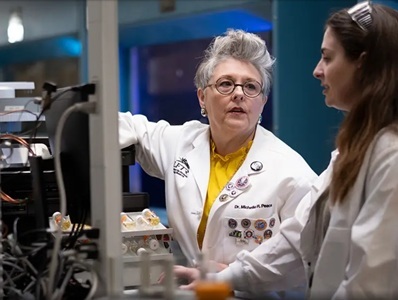
Michelle Peace, Ph.D., a professor of forensic science at VCU, works with a colleague in a forensic toxicology lab. Credit: Nathan Hanger, Enterprise Marketing and Communications
Recent testing by a Virginia Commonwealth University forensic toxicology research lab is uncovering the hidden dangers of vapes and cannabis products used by more than a million school-age children across the country each year. The study also highlights the rise of vaping in schools, where unregulated devices are increasingly found among students.
This past school year, VCU researcher Michelle Peace and her team in the Laboratory for Forensic Toxicology Research conducted extensive research on e-cigarettes, collecting and evaluating nearly 1,300 products from K-12 schools in Virginia as part of a project that exposes the ingredients in thousands of unregulated vapes and cannabis products.
The project, funded by the Virginia Foundation for Healthy Youth and the National Institute of Justice, aims to help consumers, particularly youth, make informed decisions.
“This work is important because it’s a direct measure of what children have access to - and what their preferences are,” said Peace, Ph.D., a professor in the Department of Forensic Science in VCU’s College of Humanities and Sciences. “Vaping is a significant public health and public safety threat to the well-being of our children … and [this information] serves as an educational tool for prevention and cessation.”
Tested chemicals in vapes reveal mislabeling, contaminants and risks
Of the nearly 1,300 vaping products collected from schools during the 2024-25 school year:
- 83% contained nicotine.
- 14% contained cannabinoids.
- 73% of cannabinoid vapes tested contained a mixture of cannabinoids, both plant-based and synthetic, with cannabinoid concentrations ranging from 28% to 90%.
- Vapes often advertised as containing 5% nicotine were found to contain anywhere from 1% to 4%.
- Ethanol – or alcohol – was identified in 4% of vapes that contained nicotine.
In addition to the mislabeling and various chemicals found in vapes, Peace’s research on e-cigarettes and cannabis products uncovered more hidden dangers. Most concerning to Peace was the presence of microbiologicals, such as bacteria, yeast, and coliform, the latter of which indicates fecal contamination, in the devices and in the aerosol of some of the products tested, many of which she said exceed the exposure threshold – meaning that they rise above the level of exposure at which health effects are likely to occur, raising significant concerns about the potential side effects from vaping on user health.
Vaping in schools: The growing relationship between vaping and teens
Less than 0.1% of the products submitted were authorized for sale by the Food and Drug Administration, meaning that they were overwhelmingly purchased from the unregulated market.
“I firmly believe that if you aren’t measuring a phenomenon, you cannot manage it properly,” Peace said. “[This research] provides as close to real-time data as to what schools are experiencing so they can develop strategies.”
According to a 2025 report by the Monitoring the Future, 15.3% of secondary school students in the U.S. used nicotine vaping products within the last year, while 11.5% used cannabinoid vaping products. The report’s findings are based on a survey sample of 8th, 10th and 12th grade students from around the country. Peace and her team have concerns about the generalizability of this data as school personnel continue to report a rise in vaping among the student population.
Of the 1,287 submissions received by the lab during the 2024-25 academic year, the most common brand was Geek Bar (508), followed by Raz (123) and Lost Mary (100). Students self-reported most commonly that they acquired their vaping product through a friend or peer (110), by purchasing it themselves (60) or by stealing it (18).
Republished courtesy of VCU