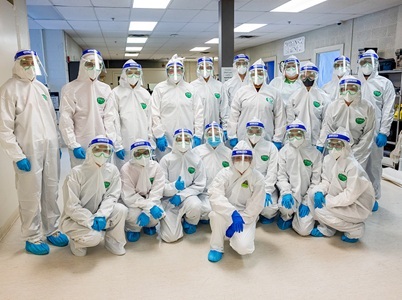
UND Forensic Science students gear up in full hazmat suits for crime scene investigation training. Photo courtesy of Lavinia Iancu/Director of UND Forensic Sciences.
When UND’s new Forensic Science Director Lavinia Iancu first arrived on campus four summers ago, she already had big designs for the 22-year-old bachelor’s degree program.
The biologist and forensic entomologist recalled telling Dean Brad Rundquist of the College of Arts & Sciences that within five years, she’d like to restructure its undergraduate program to achieve the highest accreditation from the American Academy of Forensic Sciences. Plus, she wanted to develop UND’s first Forensic Science master’s program.
Fast-forward to today, and Iancu actually is happy she’s not achieving her five-year plan. Instead …
Goal No. 1 is mission accomplished, after only four years — and accreditation could be just a few months away.
Goal No. 2 is full speed ahead with the first cohort starting this fall.
“I’m very happy and excited to see everything coming together for my students,” Iancu said. “Of course, I want all of them to be hired and to be successful, and I believe this truly is going to set them apart and help them achieve incredible success.”
Iancu was quick to credit Rundquist as being super supportive and instrumental on both counts, but the dean deflected any such praise.
“In a very short time, Dr. Iancu has aligned UND’s Forensic Science program with current student learning and workforce needs,” Rundquist said. “She has worked tirelessly the past few years, and her students will benefit for years to come because she’s making it her personal mission to prepare them to be skilled leaders ready to uphold the most rigorous standards in forensic science today.”
First master’s cohort begins classes this fall
When the master’s program was approved in late May, Iancu said students already were waiting in the wings. Eight applications are now in review, and the first cohort of graduate students is expected to start classes in the fall.
Coincidentally, that’s the same time the Forensic Science Education Programs Accreditation Commission — more widely known as simply FEPAC — will send a team to the UND campus for a site visit. They will tour facilities and interview faculty, administrators and students.
“They want to talk to people and see everything in action,” Iancu said. “They want to make sure you are doing everything that you say you are doing.”
The visit will mark one of the final stages in the yearlong application process before the professional organization decides by January whether to grant FEPAC accreditation, which is considered the gold standard in forensic science education and hands-on training.
FEPAC standards align with the same standards the FBI requires for its crime lab positions, Iancu said. If approved, UND will be one of only five FEPAC-rated institutions west of Chicago. So far, there are two in Texas and one each in Oklahoma and Utah. The 27 others are located predominantly on the East Coast.
“The process hasn’t always been easy, believe me,” Iancu said with a laugh. “These past few months have been especially complicated. I just recently finished uploading 155 documents that amounted to about 700 pages. Uff!
“They are very strict. There’s no middle ground where you can pause. No, you just need to soldier through and get it done.”
Shaping curriculum to meet FEPAC’s high standards
Of course, the preliminary work wasn’t easy either. At the start, Iancu was the only full-time faculty member in the Forensic Science program, but she quickly reached out to collaborate with other College of Arts & Sciences faculty in Criminal Justice Studies, Chemistry and Biology, as well as UND’s School of Law.
In the past two years, the department has hired two additional full-time faculty, and Iancu says she hopes to hire one more to accommodate the growing undergraduate program and new master’s program.
Since 2021, undergraduate enrollment has doubled to a total of 196 full-time majors in 2024-25. Eventually, Iancu would like to have up to 25 graduate students.
In order to meet the high FEPAC standards, 13 new courses were integrated into the undergraduate program, bringing the core science classes to 66 total credits. Courses cover everything from Firearms & Ballistics to Bloodstain Pattern Analysis and Forensic Serology to Courtroom Proceedings & Testimony for Forensic Scientists.
A dozen more new courses make up the 42-credit master’s program. Among them are Quality Assurance & Ethical Conduct in Forensic Science, Criminalistics: Biology and Advanced Fire Debris Analysis.
Undergraduates must complete a core number of science courses and choose one of three specialty tracks: Forensic Biology, Forensic Chemistry or Criminal Investigation. Master’s students have thesis and nonthesis options in both Forensic Biology and Forensic Chemistry.
Hands-on work gives students a leg up
Whether students are pursuing the bachelor’s degree or master’s, Iancu says both programs rely heavily on science and hands-on learning.
In fact, even undergraduate students spend 80% of their class time in the lab or in the field honing their analysis and critical thinking skills while using real-world investigative techniques and sophisticated technology. Many also participate in practicums or research projects, and they all have regular opportunities to connect with professionals working in the field.
For instance, Special Agent Derek Madsen of the North Dakota Bureau of Criminal Investigation, as well as State Toxicologist Janelle Portscheller and Senior Forensic Scientist Charlene Rittenbach of the North Dakota State Crime Laboratory, partner on so many exercises that they’re listed as courtesy appointments on the Forensic Science web page.
With all that science, so many specialty areas and multiple career paths, “It’s not a walk in the park,” Iancu said.
And that’s why she recently developed a student handbook, including a four-year planner with contributions from Teaching Assistant Professor Lindsay Fugleberg.
“I feel like there are so many pathways that students easily can get lost,” Iancu said. “So, I want to present them with a roadmap to take so they can graduate on time and get a job.”
The small handbook serves as a quick-and-easy reference. “These are the rules of the game. These are the requirements. These are your resources,” Iancu explained.
Iancu says she’s also considering adding a one-credit course that would help freshmen explore all of their options before customizing their college journey. All of these tools would supplement the one-on-one advice students receive from their academic advisors.
Growing programs and growing spaces
The growth of the overall Forensic Science program has not come without some growing pains.
For instance, Iancu says it’s been tight quarters with students, instructors and researchers all sharing a single high-tech laboratory space on the third floor of Ireland Hall.
“We have five instructors conducting courses in the same lab space, and some days it is quite comical,” Iancu said. “We recently had to buy carts so we quickly can switch out all the lab equipment in the 15-minute breaks between classes.”
Soon enough, however, the Forensic Science headquarters will gain state-of-the-art laboratory space in the University’s future $163 million STEM Complex. Construction is expected to begin this fall with estimated completion in the summer of 2027.
Until then, Forensic Science students will have another unique living laboratory in the form of the Gustafson Hall Crime Scene House on the south side of campus. Students already are conducting full-scale mock crime scene investigations in the three-story building that’s complete with multiple living rooms, bedrooms, bathrooms and kitchens.
“It’s an unbelievable space for setting up real crime scene investigations,” Iancu said. “We just need a few more things to make it feel like a real lived-in house. (If you have anything to donate, give Iancu a call.)
Connections count for Forensic Science students
Sometimes it helps to know people in high places — and this time we’re talking about Iancu herself.
As chair of the Pathology/Biology Section from February 2025-26, she will lead that division at the 2026 American Academy of Forensic Sciences’ Annual Scientific Conference on Feb. 9-14 in New Orleans.
The weeklong event brings together 4,000 of the world’s top forensic scientists to talk shop and learn about the latest advancements in forensic technology and criminal investigation. Along with curating receptions and business meetings, Iancu is creating a mentorship committee with her peers.
“We’re aiming to provide advice for any entry-level student interested in going into this field,” Iancu said. “My students will be able to reach out and talk face to face with all these professionals from across the United States and the world. They can get advice, learn about scholarships and all sorts of other experiences. I am very excited for them.”
Iancu says she believes in exposing her Forensic Science students to as much as she can.
“Our focus on all of the science, the hands-on skills and the real-life experiences is going to be the ace up their sleeve when they interview for the important jobs they want,” she said. “But it’s also going to really help them choose their path wisely now.”
She added: “I want them all to find joy in their future jobs. I know it sounds weird to talk about joy in the work that we do, but it’s that joy and reward that comes with knowing what you are doing is helping. So when you put your head down on the pillow at night, you can say, ‘I’ve done everything possible to help today.’ Maybe you didn’t solve the case that day, but you know you did your best to help.”
The deadline for full consideration to be approved for graduate school is Aug.1, Iancu said.
“I truly believe we are going to have a blast. I cannot wait to work on research with my students to see what kind of things we can discover.”
Republished courtesy of UND