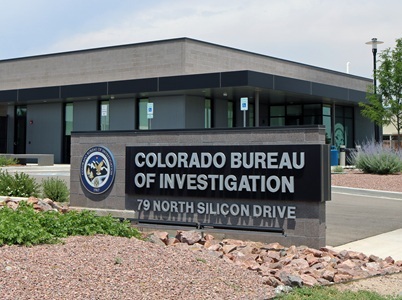
The Colorado Bureau of Investigation (CBI) office at 79 North Silicon Drive in Pueblo West, Colorado. Credit: Jeffrey Beall, July 2017
In the wake of the Missy Woods scandal, an independent assessment of the Colorado Bureau of Investigation’s (CBI) Forensic Services (CBIFS) section has found past deficiencies that included inadequate accountability, poor internal culture, a focus on productivity and gaps in crisis response.
“One recurring theme was that CBIFS’ culture under previous CBIFS leadership became narrowly centered on productivity and output, often at the expense of employee morale and long-term strategic planning. The past CBIFS leadership placed a strong emphasis on meeting casework targets and delivering forensic results quickly. While a results-driven approach can improve output, in this case, it created unintended negative consequences,” reads the report.
The assessment was conducted by Forward Resolutions, and specifically addressed CBIFS operations and leadership from 2022-2024, with some historical review extending back to 2010. The report noted that there has been significant progress forward since new leadership took over the forensic lab system in 2022.
“We ordered this assessment because transparency and accountability are non-negotiable in forensic science. The public deserves to know that science, not workload or speed, is what guides our forensic work,” said Colorado Department of Public Safety (CDPS) Executive Director Stan Hilkey. “This report and its recommendations are a necessary step in rebuilding trust, a process that is well underway and that we remain committed to achieving.”
Specifically, the report contains 52 recommendations meant to be implemented over a period of 5-10 years, some of which can be initiated administratively and at no cost and some that need resources and/or statutory changes.
The most significant recommendation is one forensic labs in the U.S. have been seeing more and more often—establishing the lab as a standalone division outside of law enforcement, in this case within the CDPS. This trend is gaining ground nationally, as many believe it can help maximize scientific impartiality.
According to the CBI, the CDPS is actively considering this idea in collaboration with the Office of State Planning and Budgeting, and will consult with the legislature given this would require statutory change.
CBI is set to begin implementing the other recommendations through a phased schedule that includes three 18-month-long phases over the next 5 years. The agency is prioritizing those that can be implemented with existing resources, and will work with the legislature to secure the funding and input required for future phases. A few of these recommendations include:
- Quality assurance: CBIFS implemented 20 procedural changes prior to the release of the report, and is in the process of implementing 21 more focusing on strengthening standards for submitted evidence, increasing transparency around quality incidents and updating key laboratory instruments and technology. This also includes hiring four additional firearms examiners and seven additional DNA analysts.
- Communications: CBIFS will establish a symposium for stakeholders to provide regular updates to law enforcement, prosecutors, defense attorneys, and judges to increase accountability, transparency, and collaboration. There will also be ongoing communications around improvements to the CBIFS Quality Assurance Program enhancements and continuing impacts of the Woods Quality Investigation.
- Organizational culture and leadership development: Implementation of a values-driven leadership training course for the CBIFS management. Clarifying performance expectations, roles and responsibilities, and internal communications, with a focus on workplace wellbeing and healthy team dynamics.
Senator Mike Weissman and Representative Jenny Willford, who both previously helped craft legislative reforms for the CBI, have agreed to sponsor new legislation informed by the report and in partnership with CDPS and other key stakeholders.
“As a legislator and sexual assault survivor, I’m deeply committed to addressing the systemic challenges at the CBI, including the impact that limited resources have had on DNA testing turnaround times,” said Willford. “This independent audit confirms that our forensic labs are stretched thin in ways that threaten the integrity of our justice system. I look forward to working with CDPS, survivors, criminal justice stakeholders and my colleagues in the General Assembly to build a stronger, more trusted forensic system for Colorado.”
At this time, CBIFS is fully accredited and operational.
Related coverage: