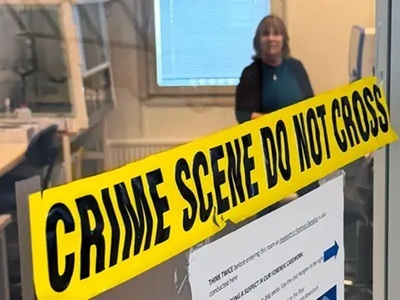
Marie Allen's research has brought closure to previously unsolved criminal cases. Photo: Robin Widing/Uppsala University
When Marie Allen began studying molecular biology in Uppsala, forensic DNA analysis was still a young research field. Today, nearly forty years later, she leads the development of methods that make it possible to analyze DNA where others see nothing.
Her interest was sparked during her studies, when a lecturer spoke about the forensic DNA analyses being carried out in the United States.
“I moved into this field during my undergraduate studies here in Uppsala. We had a lecturer who had been a postdoctoral researcher in the United States, and when he described forensic DNA analyses, I was completely fascinated. He later became my doctoral supervisor,” said Allen.
Since then, progress has been rapid—but always cautious.
“What we can do today with molecular biological techniques is beyond anything I could have imagined when I first entered the field,” said Allen. “The development has been incredibly fast. But still, you cannot work quickly in forensics. The methods are used as scientific evidence to acquit or convict in court, and therefore they must be thoroughly evaluated.”
From visible bloodstains to invisible skin cells
The greatest revolution in the field came with PCR technology, which makes it possible to copy extremely small quantities of DNA many times, until they can be analyzed. The change was dramatic: from large visible bloodstains to just a few invisible skin cells.
“In the past, you needed a blood or saliva stain the size of a five-krona coin. Today, we can examine contact traces—the skin cells we shed when we touch something,” said Allen.
Now, forensic genetics is facing the next technological leap. What is known as next-generation sequencing (NGS) is set to transform the field yet again. The technology makes it possible to analyze hundreds or thousands of genetic markers simultaneously and obtain information even from very challenging samples.
“Previously, you had to decide in advance which analysis best suited the sample and its quality. With NGS, we are moving towards an all-in-one system where you analyze the sample and see what you get. If routine markers work, excellent. If not, shorter fragments of nuclear DNA might work. If that still fails, we can examine mitochondrial DNA. In this way, we can obtain information on many different levels in a single analysis,” said Allen.
Historical mysteries benefit the forensics of the future
A central part of the research takes place far from modern crime scenes, in historical material. One of the largest projects has focused on the people who died aboard the warship Vasa, whose remains lay in water for more than three centuries. Commissioned by the Vasa Museum, Allen and her group helped uncover information about the appearance, sex and characteristics of these individuals.
“Historical samples are often far more challenging than forensic traces. That is why we work so much with historical analyses,” said Allen. “The research questions are fascinating in themselves, but the primary aim is to develop methods that work on these kinds of material—because the methods will also work on forensic traces.”
The work on the Vasa ship has demonstrated how much information can remain in the form of DNA even after several hundred years. Researchers reconstructed hair and eye color, genetic disease risks and even genetic variants linked to taste.
“Today we can find what we set out to find, so to speak. For example, we saw that most were blonde and blue-eyed, but also that two individuals had been assigned the wrong sex in facial reconstructions. Gustav, as he was called, became Gertrud instead, and Ylva became Yngve. We could also see that one individual probably did not like coriander,” said Allen.
Coriander?
“Exactly—Gertrud most likely disliked coriander. It is just a single SNP (Single Nucleotide Polymorphism), a gene variant, that determines whether you like coriander or not, and 10 to 20 per cent of people do not,” says Allen.
This methodological development—the ability to identify traits and appearance from very old material—has direct implications for modern criminal investigations.
“When nothing else works, we can often use mitochondrial DNA. We have up to a thousand copies per cell, compared with two copies of nuclear DNA. It is simply a matter of quantity, which means it works more often on difficult samples and allows us today, when investigators ask us to try again, to obtain information that we could not access in the 1990s,” said Allen.
Several high-profile criminal cases
One of the most high-profile cases where these methods made a difference was the murder of 10-year-old Helén Nilsson in March 1989.
“We analyzed mitochondrial DNA in several hairs found on Helén. We were able to exclude two suspects who had been detained for a period and later link a hair to Ulf Olsson, who was convicted in 2005. The evidential value of mitochondrial DNA is rarely high on its own, but it functions as supporting evidence alongside other findings,” said Allen.
Allen’s research group has also been involved in what is often described as the world’s largest murder investigation, the 1986 murder of Olof Palme. The work has focused on DNA traces connected to the case, including those from a walkie-talkie found not far from the crime scene a few days afterwards.
“We have mitochondrial DNA profiles and partial nuclear DNA profiles from individuals who are not among those known to have handled the walkie-talkie after it was found. We hope to carry out further analyses and obtain more information—perhaps investigative leads about appearance or ancestry,” Allen explains.
Toward an exciting future
Looking ahead, Allen expects NGS to become standard and believes single-cell technology may solve one of forensic genetics’ greatest challenges: mixed DNA traces from multiple individuals.
“If you can analyze and separate cells one by one, mixtures are no longer a problem. You can see how many cells match one person and how many match another. That provides a quantitative distribution of different contributors and will be extremely valuable,” she said.
After almost four decades in the field, Allen remains driven by the same curiosity that first awoke during her studies. Each technological breakthrough pushes the boundaries of what is possible. Sometimes a single strand of hair is enough to bring an old story to a close.
Republished courtesy of Uppsala University