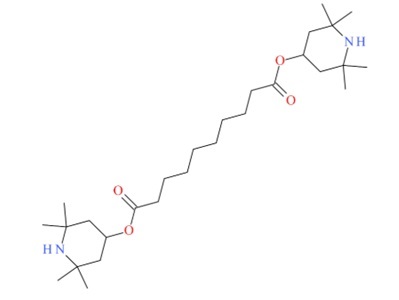
BTMPS chemical structure. Credit: CFSRE
In June 2024, befuddled forensic scientists started detecting the presence of BTMPS—a light stabilizer evaluated for use in plastic materials—in the recreational drug supply, specifically as an adulterant alongside fentanyl.
The chemical structure of BTMPS is dissimilar from most forensically relevant drugs, so scientists and chemists were perplexed by its addition. Also referred to as bis(2,2,6,6-tetramethyl-4-piperidyl)sebacate or Tinuvin 770, it contains substituted piperidine rings—a similar core moiety to fentanyl. Some suggested its use could be related to perceived enhancement of pharmacological effects of fentanyl (although there was no known evidence of that at the time), or possibly as a cutting or bulking agent.
Now, in collaboration with the Drug Enforcement Administration (DEA), the Center for Forensic Science Research and Education (CFSRE)’s NPS Discovery program has discovered new information about BTMPS, shedding light on its role in the illicit drug supply—especially its relationship to fentanyl substances.
According to the CFSRE, in early to mid-2025, forensic laboratories began detecting substances with chemical linkages to BTMPS, including tetramethyl-4-piperidinol. Soon after, they found substances with ties to fentanyl—including 4-AP and norfentanyl variants.
The emergence of these substances and relevant intelligence information now indicates the manufacture of fentanyl-related precursors, byproducts and perceived intermediates from BTMPS.
BTMPS-positive drug samples originated from Pennsylvania but have since been detected in all regions across the United States, demonstrating vast prevalence. In fact, CFSRE says BTMPS has appeared in more than 600 drug materials tested by its laboratory. Now, CFSRE can warn of the discovery of tetramethylfentanyl-related substances as well.
According to CFSRE’s recently issued public alert, tetramethyl-4-piperidinol (TMP) was first detected in August 2024 and since has appeared in more than 20 drug materials. Meanwhile, tetramethyl-4-AP (TM-4-AP) and tetramethylnorfentanyl (TMNF) were first detected in April 2025 and since have appeared in more than 10 drug materials—often together.
To date, a substance suspected of being tetramethylfentanyl (TMF) has been identified in only trace amounts alongside these other related substances; however, confirmation is pending acquisition of a standard reference material.
BTMPS has most often been identified alongside fentanyl, in addition to other synthetic opioids like para-fluorofentanyl, stimulants such as methamphetamine and cocaine, as well as other adulterants like xylazine and—second most often—lidocaine.
CFSRE’s public alert contains example chromatographs of BTMPS and five tetramethylfentanyl-related substances. The analyses were performed utilizing GC-MS and LC-QTOF-MS.
Data courtesy of CFSRE