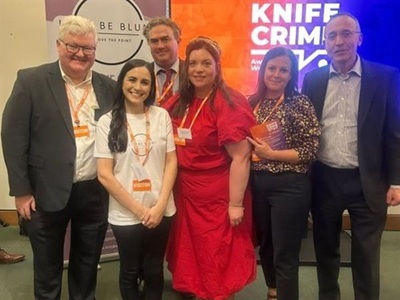
From L to R: Psychiatrist, Professor John Crichton, Leanne Lucas, Dr Duncan Bew, NHS Trauma Consultant, DMU’s Leisa Nichols-Drew, Caley Walden of Kent Police, and Andy Slaughter MP. Credit: DMU
A forensic science expert from De Montfort University Leicester (DMU) has partnered with Southport (The Netherlands) attack survivor Leanne Lucas to campaign for safer knives.
Leisa Nichols-Drew has carried out some of the most comprehensive research into the safety of round-tipped knives compared to pointed blades, finding them far less likely to penetrate materials.
Now Nichols-Drew has partnered with yoga teacher Leanne, who was critically injured in July 2024 when she was stabbed during the Stockport knife attack that claimed the lives of three children.
Leanne recently launched her Let's Be Blunt campaign, calling for the widespread adoption of rounded-tip kitchen knives. She appeared across national media, with interviews in the Times, on ITV’s Good Morning Britain and on BBC News talking about the lasting effects of her experience last year.
The campaign draws on the independent academic research carried out by Nichols-Drew, who is a Chartered Forensic Practitioner and is an Associate Professor in Forensic Biology at DMU’s Faculty of Health and Life Sciences. The research from two separate studies conducted in Leicester by Nichols-Drew demonstrates that rounded-tip kitchen knives are a clear alternative to pointed-tip knife blades, offering an opportunity for crime reduction—a knife of culinary utility without the possibility of accidental injury, and with little or no value in violent crime.
Last week, Nichols-Drew was side-by-side with Leanne at Portcullis House in Westminster for the launch of the Let’s be Blunt campaign, as part of National Knife Crime Awareness Week. The event was attended by a number of high-profile politicians and other figures interested in reducing knife crime and harm it causes, including Dame Diana Johnson, the UK's Policing and Crime Minister, Safeguarding Minister Jess Phillips, Andy Slaughter MP, Chair of the Justice Select Committee.
“It was really great to be there to support Leanne last night, and I am honored that this innovative research provides the evidence base showing that round-tipped knives are a safer alternative," said Nichols-Drew. “Hopefully now will be able to build on this momentum to bring about policy change and make society safer.”
That evidence base comes from two studies conducted led by Nichols-Drew and involving colleagues from the universities of Leicester and Northumbria, comparing pointed and round-tipped knives. The first in 2020 rigorously compared 300 repeated stabbing motions on everyday clothing such as cotton t-shirts and denim jeans and found a range of round-ended knives did not penetrate the fabrics at all, while sharp-pointed knives did.
A second set of tests conducted in 2024 looked at the damage caused by a similar range of bladed articles to special forensic simulant materials beneath fabrics. The preliminary findings of the study, which is yet to be published, support the previous peer reviewed work and show a clear connection between the shape of the tip of a blade and resulting clothing damage.
Nichols-Drew has long been involved with efforts to improve knife safety and is member of the Safer Knife Group, a collaboration of experts including a forensic psychiatrist, a trauma surgeon, a former member of the judiciary, the CEO of the knife crime prevention charity, the Ben Kinsella Trust, and Andy Slaughter MP.
Republished courtesy of DMU