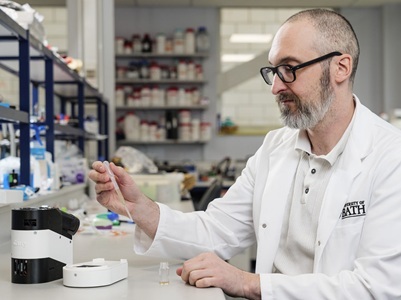
The new device can identify substances such as synthetic opioids, which are major contributors to drug overdoses. Credit: Chris Pudney/University of Bath
Last year, Devon & Cornwall Police (UK) found oxycodone tablets at the site of a suspected overdose death. Normally the police would collect the tablets and send them to a forensic drug detection service to confirm the substance, with results expected back in weeks to months. However, this time, the police were trailing a new portable device that can instantly detect drugs at extremely low concentrations.
The technology worked. At the scene, the tablets were found to contain a nitazene, allowing authorities to put out a drug warning within 36 hours of the initial death—possibly saving others from a similar fate.
The rise of synthetic drugs has made the landscape of drug use even more dangerous, especially for unaware users. For example, a person may think they are taking a known dosage of a known drug with well-understand effects. However, if a synthetic drug was added unknowingly, it becomes a much more dangerous situation for the user.
“This is why drug checking is so important and so needed. We need simple, instant detection that anyone in a drug and alcohol service can use to support their clients,” said biochemist Chris Pudney, who leads the University of Bath team who developed the technology.
The device is similar to an ultraviolet spectrometer, replying on a combination of fluorescence and reflectance spectroscopies. The device is also trained using a deep-learning algorithm, meaning it was exposed to a library of nanoparticle spectroscopy (NPS) light patterns from which it learned to make accurate identifications. These identifications can be made in real-time, revealing both the contents of a substance and the concentration of each ingredient at extremely low concentrations.
“Our device would support community harm reduction,” said Pudney. “Telling people not to take drugs doesn’t work, so different strategies are needed. By letting people know exactly what’s in a drug and how strong it is, we can empower them to make safer decisions about whether or not to take it, or to use it in a safer way.”
Additionally, while most in-lab spectrometers need to be run by trained chemists, this field device can be operated by a non-expert, yielding results with just the press of a button. In fact, portability is one of the device’s defining characteristics. The University of Bath team said they envision the device being deployed in areas where illicit drugs are commonly used, such as clubs and festivals.
“Whatever we’re doing at the moment to prevent deaths from drug misuse isn’t working so we need a new kind of service that can be where it’s needed—cheaply, easily and anywhere,” said Pudney.
In addition to the Devon & Cornwall Police, the device is being trialed by drug-checking services in the UK, Norway and New Zealand.
For two weeks last year, hundreds of drug samples were tested in New Zealand using the device as part of an initiative involving the country’s three front-line drug-checking services: the Drug Injecting Services in Canterbury Trust, the New Zealand Drug Foundation and KnowYourStuffNZ. New Zealand is one of few countries in the world where drug-checking services are explicitly legal.
“The spectrometers that we use are currently the best tech for mobile drug analysis, but science moves ever on. The University of Bath’s new technology could help us help our clients with better and faster analysis of their samples,” said KnowYourStuffNZ deputy manager Jez Weston.
Norway is another country that operates community-based drug checking and has had a positive experience with the device.
“The new device from Bath is helping us fill this gap—it’s very exciting for us to be trialing this new technology, said Dagfinn Hessen Paust, chief scientific officer at the Dagfinn Hessen Paust, chief scientific officer at the Association for Safer Drug Policies.
The Loop Drug Checking Service is the only community-based drug-checking service in the UK that has been granted a license for such work. It has been operating in Bristol since 2024 and also uses, alongside other analytical technologies, the University of Bath device.
Nick Burnett, a drug expert witness for Devon & Cornwall Police, says use of the technology has improved the police’s working relationship with drug treatment services, especially in relation to information sharing and, where necessary, issuing of drug warnings.
“Our aim is for this device to support drug-checking services as a means to decrease the harm caused by drugs across different groups. The landscape of drug use is changing rapidly and we hope this tool can fill some of the gaps that are emerging,” said Pudney.