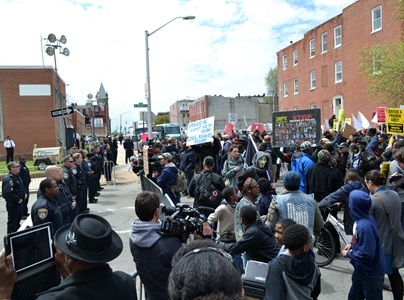
Protest at the Baltimore Police Department Western District building in 2015. Credit: Veggies
An independent audit found that 36 deaths in police custody over a two-decade span in Maryland should have been ruled homicides by the state’s top medical examiner Dr. David Fowler, who became a household name after he testified that George Floyd’s death was not a homicide but rather due to “excited delirium.”
Following the trial in April 2021, over 450 medical experts co-signed a letter to then-Maryland Attorney General Brian Frosh and others condemning Fowler’s testimony as showing “obvious bias” and demanding a review of all the deaths in custody investigated by the Maryland OCME during Fowler’s tenure as chief medical officer (which ended in 2019, before he served as an expert witness in the Floyd trial).
The resulting, yearslong audit was released Thursday with concerning results, including “patterns consistent with racial disparities in death classifications, and the use of discredited diagnoses such as ‘excited delirium.’”
“Our audit’s findings exposed profound failures that denied families the true picture of what happened to their loved ones and weakened public trust in our institutions,” said Attorney General Anthony Brown.
From a review of over 1,300 OCME cases of death in custody from 2003 through 2019, the audit team identified 87 cases for inclusion, each involving an unexpected death during or soon after restraint.
According to the report’s findings, the independent forensic reviewers disagreed with the OCME’s original determination of the manner of death in 44 out of the 87 cases—including 36 cases the audit reviewers deemed homicides but OCME ruled either undetermined, accidental or natural. In these 36 cases, the reviewers unanimously—3 out of 3—concluded the death should have been classified as a homicide.
These cases include high-profile deaths, such as Anton Black, the 19-year-old who died while being restrained by officers in 2018. The list also includes Tyrone West, 44, who died after allegedly being beaten by Baltimore Police officers in 2013, as well as Dondi Johnson, 43, who was paralyzed and later died after riding in a police van.
Twelve of the 36 cases that should have been ruled homicides mention the use of tasers by police. For example, Thomas Campbell, 50, died after he was shocked with a taser by Baltimore Police officers in August 2007. Media reports at the time noted Campbell was the fifth death in 2007 alone linked to police use of tasers.
In 42 of the 87 audit cases, OCME’s cause-of-death statement referenced “excited" or "agitated" delirium, which has been widely rejected as a valid cause of death. In those cases, OCME almost always certified the manner of death as “undetermined” with only one case ruled a homicide. In contrast, audit case reviewers deemed 25 of those same 42 deaths to be homicides. In 5 additional cases, 2 out of 3 reviewers concluded the death should have been classified as a homicide.
While reviewing the cases, the auditors noted that deaths involving Black individuals and deaths involving law enforcement restraint were significantly less likely to be ruled homicides compared with others.
“For deaths that case reviewers unanimously judged as homicides, OCME rarely certified the manner as homicide, and they did so even less often if the decedent was Black,” reads the official audit report.
Lastly, the auditors found systemic deficiencies in autopsy reports including:
- failure to acknowledge restraint as a potential contributing factor when appropriate
- correctly acknowledging restraint as a contributing factor but not certifying the death as a homicide (thus violating the “but-for” standard that requires deaths resulting from another person’s actions, regardless of intent, to be certified as homicides)
- did not provide adequate justification for determinations
Autopsy documentation was also found to be incomplete, including missing photographs and incident information, such as the absence of available body camera footage.
Maryland’s response
The day the report was released Maryland Governor Wes Moore signed an executive order to improve accountability and transparency in the conduct of in-custody restraint-related death investigations. Effectively, the order extends the cooperation already underway that has allowed the state to execute this first-in-the-nation audit model.
“Maryland was the first state in the nation to launch a comprehensive, methodical, and objective audit of our Office of the Chief Medical Examiner. And today, we become the first state in the nation to respond to such an audit with responsible action that brings everyone to the table,” said Moore.
The expansive executive order directs the attorney general to review each case included in the audit to determine if the case should be reopened for investigation.
It also creates the Maryland Task Force on In-Custody Restraint-Related Death Investigations—a multidisciplinary entity that will implement ways to reduce the risk of in-custody restraint-related deaths, improve death investigations associated with these kinds of deaths, evaluate current training standards for law enforcement, and promote greater collaboration with mental health and substance abuse professionals. The task force will also make recommendations on whether to establish a permanent committee to review future manner-of-death determinations for all in-custody restraint-related deaths, as well as if a second audit is needed.
The new executive order builds upon previous action the Maryland Department of Health implemented to increase oversight and accountability in the OCME including Moore’s HB969, legislation that allows decedent families to petition the OCME to correct findings and conclusions related to the cause and manner of death.
Audit design
The Office of the Attorney General hired 12 independent forensic pathologists, who were initially blinded to the decedent’s race and OCME’s original conclusions. Three reviewers were randomly assigned to review each case and make their own independent determinations of the manner of death. If the reviewers’ conclusions were not unanimous, they discussed the case in an attempt to reach a consensus.