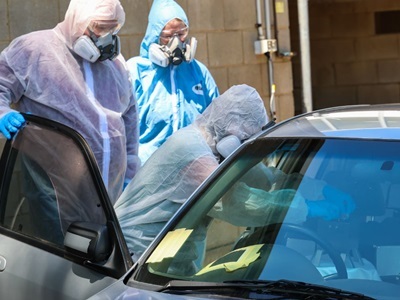
Flinders University researchers are investigating third-hand contamination risk from methamphetamine use. Credit: Flinders
Environmental health experts at Flinders University have found most surfaces in a car retain traces of methamphetamine after it’s been smoked in the vehicle, putting subsequent users of the car at risk of third-hand exposure to the drug.
Small-scale testing of two used vehicles, under special licence and controlled conditions, found meth in 85% of surface wipe samples and 93% of bulk material samples after simulated smoking events. All six air samples detected methamphetamine.
“Testing and remediation for methamphetamine in contaminated vehicles is necessary to protect public health,” says Kirstin Ross from the College of Science and Engineering. “Cars can be used to smoke, manufacture and transport methamphetamine and subsequent passengers or drivers of contaminated vehicles could be exposed to the drug, third-hand.”
Individuals exposed to indirect contamination may have adverse health symptoms including respiratory problems, headaches and behavioural and cognitive issues. This makes it important to determine the overall methamphetamine contamination extent of cars to provide the public with safeguards when buying or using vehicles, the Flinders University experts say.
Flinders experts including PhD in Forensic Chemistry and Environmental Health, Gemma Kerry, whose research is investigating the risks of third-hand contamination from meth, have published the latest results in a new article in Forensic Chemistry.
The study was undertaken to determine the extent and distribution of contamination on surfaces, in air and from porous materials in two cars that tested positive for methamphetamine. One of the two vehicles was earmarked to be destroyed.
“These results demonstrated that methamphetamine can be detected in air, on the surfaces of non-porous and porous materials, as well as from within porous materials,” says Kerry. “The results also demonstrated that methamphetamine was still able to be detected from a second, third and fourth wipe sampling event of a plastic surface, indicating that there is a necessity for further research on testing and remediation in cars.”
Law enforcement agencies, vehicle dealerships, vehicle lenders and owners are challenged with testing and cleaning contaminated vehicles, in particular stolen or second-hand cars.
“Detecting the presence and concentration of methamphetamine in different areas of the car can give us clues as to what led to this contamination. For example, high concentrations in the roof lining above the driver or each of the passengers indicate who was smoking, whereas higher levels in the boot indicate transport of the drug there," said author Stewart Walker.
Republished courtesy of Flinders University