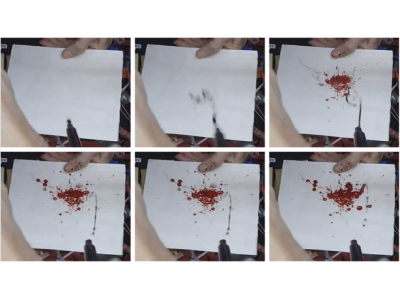
Fluid volume ejection and stain creation in microgravity. Credit: Zack Kowalske, George Pantalos, Abdulrahman Oleiwi, Graham Williams.
As humanity advances into a space-faring species, the risk of injury by multiple means and intentions will follow. Expanding understanding of how forensic science adapts to extraterrestrial environments is a novel and inevitable expansion into the next forensic frontier. This study considers the unique challenges of bloodstain pattern analysis in microgravity environments. Specifically, observation in novel experimentation aboard a parabolic flight research airplane which yielded fluid dynamic behaviors in a microgravity environment that provides practical understanding of Earth-based and off-world bloodstain applications.
This investigation considers the discipline of bloodstain pattern analysis (BPA) in a gravity-altered (reduced) environment or an environment that exhibits gravity at a degree other than Earth-normal. Contemporary BPA reconstruction relies on the measurements of individual bloodstains to determine the flight path of the blood droplet. Within this reconstruction, the analyst is determining three key metrics: the angle at which the blood drop struck the surface (known as the angle of impact), the two-dimensional area in which the stains from an overall pattern intersect (the area of convergence), and the volume in space at which the stains intersect (the area of origin). These three metrics assist in determining where liquid blood originated, an essential aspect of event reconstruction. By removing the influence of gravity, we can isolate the principal equation of the angle of impact estimation and therefore better understand the independent forces acting on bloodstains in terrestrial environments.
Where the inception of BPA research was conceived from 19th-century forensic medicine, the future application of BPA in extraterrestrial environments will evolve from the research of 21st-century space medicine. Early astroforensic research within BPA can aid in at least three applications: (1) the investigation of eventual violent criminal acts that occur outside of Earth's environment, (2) accident reconstruction onboard space station/starship platforms, and more immediately applicable by (3) providing a better understanding of blood flight and deposition action terrestrially in the reduction or absence of gravitational forces. [Note: Moon = 0.166 g, Mars = 0.378 g, Earth orbit = 10-6g].
The foundational mathematical relationship in BPA is the ratio between the stain’s width and length as a function of the angle at which the drop struck the surface. This angle is a crucial step in any reconstruction of impact stain patterns and is reflected in the angle of impact equation. However, this core calculation fails to account for any environmental variable, including gravity or air resistance.
At the core of the present pilot study, we hypothesize that if gravity is removed as an acting force on a blood drop in flight, then the calculated angle of impact will be more accurate.
The singular question remains at the core of this study: does a blood drop, in the absence of gravity, interact with a surface so that the shape alone exhibits physical characteristics that can relate to the flight path and origin of that droplet? Despite surface tension and cohesion altering the stain's shape and size, stains can retain shape characteristics that indicate vector directionality. The fluid dynamics and behavior of liquid droplets in microgravity is an essential study in contemporary scientific and engineering fields such as space medicine, fluid/fuel management systems, and rocket design and performance. The properties of surface tension and cohesion are crucial to understanding and controlling the behavior of droplets in these disciplines, as well as relevant to the forensic application of BPA in the unique microgravity environment. Studying bloodstain patterns can be a crucial aspect of forensic science, as they provide valuable reconstructive information. However, little is known about how liquid blood behaves in flight or during the deposition in an altered gravity environment. This is an area of study that, while novel, has implications for forensic investigations in space or non-terrestrial environments with reduced gravity while simultaneously assuring accurate metric estimations on Earth. This suggests that analysts must consider environmental effects when analyzing bloodstain patterns in any setting. With the rate of technological evolution in space exploration advancing humanity's pioneering into the extraterrestrial frontier, the need for reliable forensic science techniques will become increasingly important. Although the effects of microgravity present unique challenges for investigators, understanding the variables and physical forces at play can lead to a more reliable interpretation of bloodstain patterns both on and off Earth.
Republished courtesy of ScienceDirect.