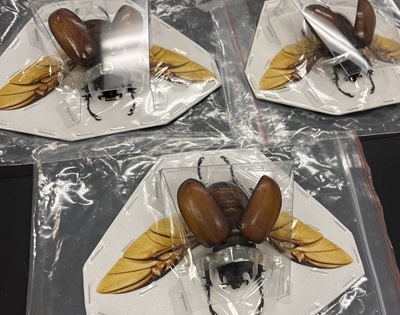
One of the bugs from the new collection at ASU. Credit: ASU
Most of the time, when forensic entomologists are working with insects, it is because they have been found on human remains and potentially contain vital information about the crime law enforcement is investigating.
But for Lauren Weidner, assistant professor at Arizona State University (ASU), the insects are the victims this time.
Weidner recently helped her department at ASU acquire 3,000 black market bugs she serendipitously stumbled upon on a visit to the National Fish and Wildlife Forensics Laboratory in Oregon. The bugs had been confiscated upon entering the country and were later exiled to the lab, which was to become their final resting spot—until Weidner got a glimpse of them.
Now, they are scattered among seven boxes in Weidner’s lab.
“Insects are among the most illegally smuggled species and people have no idea,” said Weidner. “This project is something that’s important to me, and although forensically relevant, it’s different from what I normally do. These insects are beautiful, they’re exotic and—unlike my normal cases—they’re the victims. It’s heartbreaking that these insects were taken and stored away as evidence.”
The collection contains insects in a range of sizes, colors and shapes. Some are as small as a shelled sunflower seed, while others are more than six inches long. A few, like the Marmessoidea rosea, a walking stick bug from Malaysia, seem as soft and delicate as a flower. Others, including variations of the stag beetle, have abdomens that look as hard and strong as a pair of Doc Martens.
They come in an array of colors. Some are iridescent; others, such as the Mexican spider, are a metallic turquoise color. And still others combine shades and patterns that would impress a high-end designer.
The collection also has two specimens of the world’s largest and rarest butterfly—the Queen Alexandra’s birdwing, which has a 10-inch wingspan and can fetch as much as $100,000 on the black market.
In the spring, Weidner, her lab manager and a team of six undergraduate students plan to sort through the insects. Their goal is two-fold: first, to understand which insects are trafficked into the United States and second, to create information sheets about each of the insects, which they hope can be used federal agents, local investigators and attorneys in the field. The detailed information could help authorities identify insects coming into the country from as far away as Malaysia, Laos and Thailand.
Additionally, Weidner’s lab will be collaborating with several entomology experts in different groups, a nonprofit organization, co-existence advocates, a federal prosecutor and the National Fish and Wildlife Forensics Laboratory that acquired the specimens in the first place to raise awareness of insect trafficking. Ultimately, the bugs and the data Weidner’s team uncovers will be displayed in various locations, including museums, to further inform public education.
“Doing this work makes me feel like the bugs were not taken for nothing,” said Weidner. “To be able to gather the information needed to help prosecute the criminals doing this and educate the public about this activity makes this project a win-win.”