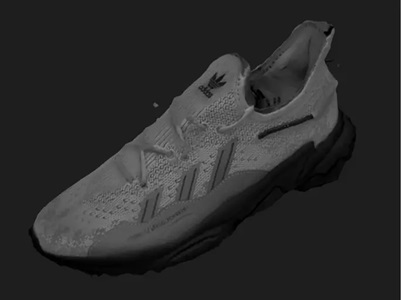
The new method uses 3D scanning to identify criminal's footwear. Credit: Staffordshire University
Over the past decade, advancements in recording technology have exploded. Nearly everyone on the street has a phone capable of high-quality film capture, in addition to CCTV footage, home security cameras, body-worn cameras and more.
Theoretically, that means it should be easier to identify criminals with the amount of footage available. For example, police were able to narrow in on Bryan Kohberger as the main suspect in the University of Idaho quadrupole murder case after they saw his car on numerous surveillance videos from both residences and businesses.
Of course, footage is not always straightforward. In addition to not being pointed in the right direction or having some other type of view obstruction, criminals often conceal their face and wear dark clothing, successfully limiting their identifying features. What they often do not take into account, however, are their shoes.
While the analysis of footwear impressions left at crime scenes is a well-established forensic practice, forensic experts in the UK have teamed up to take footwear analysis to the next level.
Researchers at Staffordshire University and experts at West Yorkshire Police are collaborating on the development of a new system that uses 3D scanning technology to help identify the type of footwear worn by criminals.
“Most CCTV cameras use near infrared light during nighttime recordings, which can make the footwear look completely different than in natural light,” said researcher Claire Gwinnett, professor of forensic and environmental science at Staffordshire. “So, it was important to develop a method that will help police to quickly identify the type of shoe, how common it is, and importantly what it looks like under different lighting conditions.”
Using a photography light box, turntable and camera, the fast, effective and affordable method captures data from footwear by creating an interactive 3D image of a shoe under both visible light and infrared light.
“We record a video of a shoe on the turntable under each lighting condition, extract the frames and put it into software that stitches it all together to make a 3D model. The idea is that you can set it up and leave it to record then come back when it has finished,” explains postdoctoral researcher Megan Needham.
The new method only takes about 30 minutes in total, with equipment costing less than £500.
Needham is currently refining the optimum settings for the process before it is piloted by different police forces in the UK in the new year.
In future, it is hoped that this method could be adopted to populate a national database of footwear that could be accessed by police professionals across the country. The researchers envision officers using the method to quickly scan a suspect’s shoe to see if it’s a match to any previous crimes—akin to how DNA is run through local databases and CODIS for a match currently.
“Having access to a searchable database of interactive, 3D models of footwear under both white and near infrared light will greatly improve the accuracy and efficiency of the current process,” said Selina Reidy, an identification expert with the West Yorkshire Police. “This work will expand and improve the current evidence base and, with continued development, will provide an additional forensic capability that informs police investigations.”
Staffordshire University will host a workshop for police professionals about the research in March 2023.