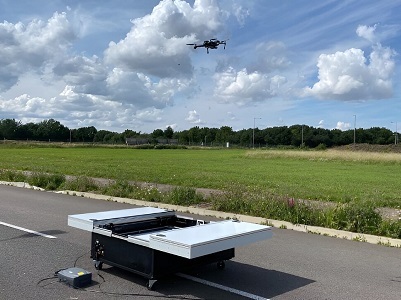
Credit: HeroTech8
Researchers in England used real-world data of fatal opioid overdoses to show that naloxone-delivering drones reach patients in 7 minutes or less in 78% of cases—compared with 14% reached by ambulances in that timeframe.
The modeling suggests the naloxone kit would be delivered to the site of the overdose, and a bystander would administer the medicine by nasal spray. Paramedics would attend the scene as usual and deliver the patient to urgent care.
The researchers say their study provides proof-of-concept that—at least in the Teesside area of the UK—drones are more likely than an ambulance to get naloxone to the site of an opioid overdose.
For the study, published in Addiction, the King’s College London team examined opioid overdose cases with bystanders likely present that occurred in the Teesside (UK) area over a five-year period from 2015 to 2019. Cases with bystanders present were selected as someone would need to call for and administer the delivered naloxone. Additionally, the Teesside area was selected as it comprises a range of urban, semi-urban residential and rural areas.
Analyzing the data provided by the National Programme on Substance Abuse Deaths, the researchers found 58 cases that matched the study criteria.
The team, including lead author Caroline Copeland, chose C1 class drone models for naloxone transit as they are lightweight enough to be flown legally under Civil Aviation Authority regulations, but also sufficiently powered with a maximum airspeed of about 42.5 mph. These drones also have collision detection technology, so they don’t fly into buildings or through air space, and are deployed using a standalone drone station.
In analysis of real-world data and experimentation, the researchers found estimated that drones arrive in 7 minutes in 78% of overdose cases (45 out of 58). In those same cases, ambulances were estimated to arrive in 7 minutes in 14% of the time, as long as traffic was “best case scenario.” In high-volume traffic conditions, ambulances were estimated to arrive in 7 minutes in only 7% of the overdose cases.
In all examined cases, the drone would have arrived before the ambulance.
In 13 cases, bad weather—namely low temperatures and high winds—prohibited drones from taking flight. However, the researchers say technological advances can address this challenge. For example, an insulated cargo cradle could keep the naloxone at a stable temperate, despite the outside temperature. The team also found that prevailing wind speed and direction could be negated by enhanced C1 drone speed. With these improvements, the study estimates that drones would reach opioid overdose patients in 7 minutes in 98% (57 of 58) of cases.
It's important to note that there were no cases of opioid overdose located in central urban areas, which are more difficult to access by drone, but rather localized to semi-urban residential areas where opioid use is known to be more common.
“When a person overdoses and stops breathing, every second counts,” said Copeland. “Naloxone is very effective when given at the first signs of overdose and is easy to use. This study shows that drones can get naloxone to the site of an opioid overdose more quickly than paramedics in an ambulance. This could make a huge difference to people’s survival. Drones have the potential to revolutionize medicine delivery.”