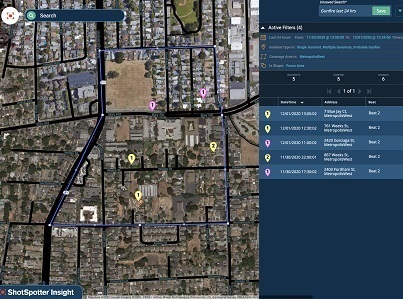
Example of ShotSpotter interface. Credit: ShotSpotter
Seattle Mayor Bruce Harrell hopes to use $1.8 million in unspent police salaries on three crime prevention techniques—CCTV cameras, an acoustic gunshot locator system (AGLS), and automatic license plate readers—according to his 2024 proposed budget.
The mayor’s office says the first focus would be on a CCTV camera system that could be connected to integrate AGLS.
“CCTV cameras, when coupled with other crime prevention measures such as improved lighting, trimming of overgrown vegetation, community awareness, and police patrols, can be an important tool to help deter criminal behavior at specific places where crime is concentrated,” the mayor’s office said in a statement.
The office also specified that the CCTV cameras would only be used to monitor public places, such as sidewalks, streets and parks, in neighborhoods where gun violence, human trafficking and other persistent violent crime is concentrated. Officials say video captured by the cameras would be automatically erased after 30 days, and AI face-recognition technologies will not be used.
Harrell has advocated for acoustic gunfire technology for years. Last year, his proposal—which included an acoustic-only system, as opposed to video—was shot down by the city council.
The largest and most well-known acoustic gunfire technology in the U.S. is Soundthinking’s ShotSpotter. The ShotSpotter system uses well-placed microphones and triangulation services to alert police of the precise location of almost all gunfire within a city’s coverage area within 60 seconds.
However, the system is controversial. A June 2021 peer-reviewed paper concluded that ShotSpotter may be of little benefit to police agencies and does not reduce violent crime. Then, VICE News wrote that police in Chicago are altering evidence using the system—a claim ShotSpotter has vehemently denied, calling the allegations false and misleading.
Back in Seattle, the ACLU of Washington appalled the decision last year by the city council to reject Harrell’s request for ShotSpotter, citing privacy concerns.
This time around, Harrell says the technology will help protect racially diverse neighborhoods that are impacted most by gun violence.
“This project aims to reduce serious criminal behaviors that cause great harm, especially among people of color who are overrepresented as victims, and to hold offenders accountable so that places where crime is concentrated, can become safe for everyone,” the budget proposal said.
The last technology proposed in the budget is the expansion of automatic license plate readers (ALPR), which can identify stolen vehicles and vehicles associated with court-ordered warrants. The technology is already deployed in 11 Seattle Police Department (SPD) patrol vehicles and 15 parking enforcement vehicles.
Harrell’s office says an expanded ALPR capability will allow SPD to address the growing problem of stolen car thefts. This year, through September, motor vehicle theft increased citywide by 36% compared with the same period in 2022—from 4,318 to 5,858 incidents. Since the pre-pandemic year of 2019, vehicle theft has soared 232% in Seattle—from 2,521 to 5,858 year-to-date.
“Technology tools can boost police effectiveness in gathering evidence, addressing crime and holding offenders accountable. This is especially true in Seattle, as these technologies will strengthen efficient use of resources and personnel given currently low staffing levels,” the mayor’s office said in a statement.
Next, the city council will vote on whether to approve the budget item as described.