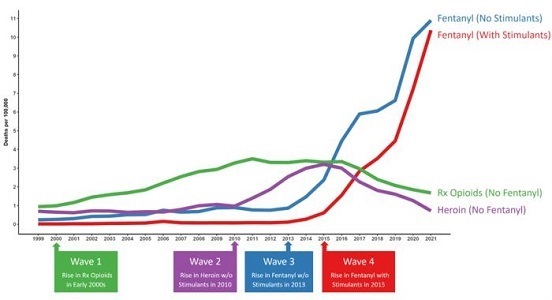
A simplified schema of the four waves of the U.S. overdose crisis. Data from CDC WONDER. Credit: Friedman and Shover, 2023, doi: 10.1111/add.16318.
New research out of UCLA shows the proportion of overdose deaths in the U.S. involving both fentanyl and stimulants has increased more than 50-fold since 2010—from 0.6% (235 deaths) in 2010 to 32.3% (34,429 deaths) in 2021.
The rise in fentanyl + stimulant fatalities is the “fourth wave” of the long-running opioid crisis, this one first seen in 2015. The crisis started with the initial rise in deaths due to prescription opioids in the early 2000s, followed by the second wave of heroin-associated deaths in 2010. Around 2013, an increase in fentanyl overdoses signaled the third wave, before experts began seeing many fentanyl overdoses with stimulants in 2015—a wave that continues to grow.
It has grown so much that the proportion of other overdose deaths has actually dramatically fallen. For example, overdoses containing neither fentanyl nor stimulants accounted for 16% of deaths in 2021, compared with 77.3% in 2010.
“Fentanyl has ushered in a polysubstance overdose crisis, meaning that people are mixing fentanyl with other drugs, like stimulants, but also countless other synthetic substances,” said lead study author Joseph Friedman. “This poses many health risks and new challenges for healthcare providers. We have data and medical expertise about treating opioid use disorders, but comparatively little experience with the combination of opioids and stimulants together, or opioids mixed with other drugs. This makes it hard to stabilize people medically who are withdrawing from polysubstance use.”
According to the new study, published in Addiction, both overall and in specific groups, the highest prevalence of stimulant involvement in fentanyl overdose deaths was observed in individuals ages 25 through 54, with generally lower rates among the youngest and oldest individuals. Meanwhile, the intersectional groups with the highest proportions included 65 to 74-year-old non-Hispanic Black or African American women living in the West (73.3%), as well as 55 to 65-year-old Black or African American men living in the West (68.7%).
The study authors also observed geographic patterns to fentanyl/stimulant use. Polysubstance abuse hit the Northeast first, as heroin became the most common co-involved substance in 2014 in five states in the region. In 2019, cocaine became the most commonly co-involved substance in seven states. Then, by 2021, all states in the Northeast had a stimulant as the most common co-involved substance, with seven having cocaine and two having methamphetamine.
Among states in the West region, a mixture of prescription opioids, benzodiazepines and alcohol were the most common co-involved substances until 2020, when methamphetamine became the most common in 10 states, ultimately growing to all 13 states the next year.
Meanwhile, the Midwest and the South saw a more mixed profile, with brief periods of heroin/fentanyl predominance in numerous states between 2016 and 2018. By 2021, methamphetamine and cocaine were the only leading co-involved substances represented in these regions, with 19 and 10, respectively, of a total 28 states and the District of Columbia.
“The rise of deaths involving cocaine and methamphetamine must be understood in the context of a shifting illicit opioid drug market increasingly dominated by illicit fentanyls,” the study authors urged.
Indeed, an additional facet to the opioid crisis is the growing prevalence of counterfeit pills, which resemble psychoactive pharmaceuticals such as oxycodone or alprazolam but contain illicit fentanyls, often mixed with other illicit substances, such as stimulants, benzodiazepines, xylazine and other opioids.
“In the ongoing surveillance of the U.S. overdose crisis, tracking deaths involving counterfeit pills versus other formulations represents an important dimension that is currently difficult within the existing data landscape,” conclude the study authors.