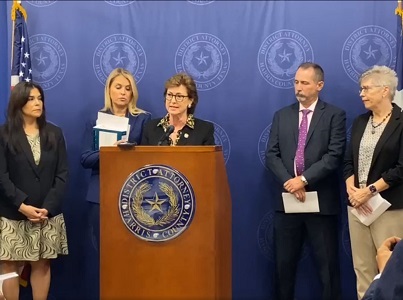
Harris County District Attorney Kim Ogg with law enforcement officials and families of murder victims on Wednesday. Credit: Harris County DA
On Friday, a new law takes effect in Texas to prioritize murder trials. But, Harris County District Attorney Kim Ogg said that prioritization won’t mean anything with continued delays at local crime labs, specifically the Houston Forensic Science Center.
“We at the District Attorney’s Office are ready. Our friends in law enforcement are ready,” Ogg said. “Now we need the City of Houston to ensure that our evidence is ready.”
As of Aug. 22, 2023, over 1,800 murder cases were pending in Harris County, Texas, with nearly half of those suspects remaining at large, either as fugitives or on bond. Right now, families of murder victims must wait an average of 3.5 years for their cases to reach trial, although the wait time can go as high as 7 years.
According to the DA’s office, the COVID-19 pandemic cased backlogged cases to jump dramatically—from 389 to 556 in 2020. This, in turn, created a backlog at the city’s crime labs.
The Houston Forensic Science Center’s largest backlog is seized drugs at 1,561 cases. Backlog numbers for other forensic lab sections are as follows:
- Sexual assault kits- 623
- DNA (non-sexual assault kits)- 571
- Latent print processing- 366
- Toxicology/drugs- 350
- Firearms- 291
- Digital multimedia- 92
- Latents- 62
- Crime Scene Unit- 13
Additionally, total turnaround time for some of the sections is over one year or nearly one year, including: latent processing (557 days), digital (339 days), firearms (325 days), and drug toxicology (317 days). Non-outsourced DNA has a turnaround time of 222 days.
Standing next to families of murder victims Wednesday to acknowledge the new state law taking effect today, Ogg called on Houston Mayor Sylvester Turner and the city to fully fund the Houston Forensic Science Center and to outsource all backlogged evidence testing. However, in a statement released the same day, Turner said the city has provided the center with all the resources it's asked for, along with nearly $5 million in the city's budget—and more to possibly come.
The provided resources thus far include:
- $300 K in overtime funding for CSU and firearms
- $400 K to outsource toxicology cases
- $2 M to train new employees
- $900 K for specialized firearms training
- $500 K for digital forensic systems upgrades
- $250 K for temporary labor to reduce backlog
- $600 K to outsource digital multimedia