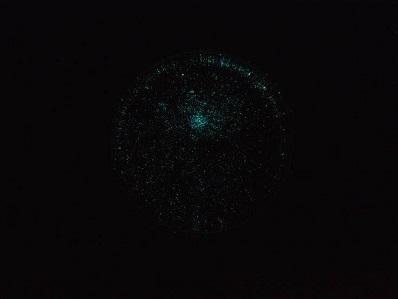
Luminescent sand. Credit: AUAS, Nicole Roelofse
Netherlands Forensics Institute (NFI) experts conduct scientific research to help solve complex forensic issues using innovations. But as they just discovered, sometimes, the solution is surprisingly simple.
Experiments to study how glass behaves in crimes typically take days of work. That is, until a possibility to accelerate the investigation suddenly presented itself. In this case, it was something you can pick up in a hobby shop: glow-in-the-dark creative sand.
“It can be so easy sometimes,” said Jaap van der Weerd, an NFI researcher. “Now we can test scenarios quickly and easily.”
Glass plays a part in a range of crimes, for instance in burglaries where the perpetrator breaks a window. ATM robberies using explosives also leave glass fragments on the perpetrator’s clothing. If there is an actual suspect, the NFI can compare the glass fragments on the clothing against the glass at the crime scene. If there is a match, the suspect has some explaining to do. But sometimes, that explanation is: “I’m not the burglar, it was someone else I rubbed up against at the bar. That’s how the glass was transferred.” Yet, how probable is that really?
The NFI wants to know how trace evidence behaves to be able to make a well-founded statement in such cases. When are traces transferred? How do you lose them? This is why they started developing methods that help improve trace behavior investigation two years ago—sarting with glass traces in a partner project with Amsterdam University Of Applied Sciences (AUAS).
Slow going
Studying the behavior of glass particles is complex since they are often not visible to the naked eye.
“Reconstructions of crimes with glass traces are time-consuming when you use traditional methods,” said Van der Weerd. “Say that we find glass fragments on the clothing of a suspect in a burglary. But that person says they are innocent and the glass particles were transferred via the coat of the real perpetrator, which hung next to his. In such a case, you want to investigate whether their story is plausible.”
Investigators then break a window so glass ends up on a coat. Then they have to shake out the coat at the lab to loosen all of the glass fragments. These are minute fragments that they then study and count under a microscope. This can take days, since it is not just glass that you shake out of the coat. There is sand as well, and they look very much the same.
“You have to repeat this a couple of times. You then hang the coat on a coat rack, after which you repeat the whole thing. You then study the coat that was hung against the first coat to see whether you find any glass particles, and if so, how many. Reconstructing such a scenario is slow going,” said Van der Weerd.
Ingenious camera system
Thus, the team wanted to speed things up.
“We came up with the idea of searching for material that is both representative of glass and can be easily visualized,” said Van der Weerd. “That is how we discovered glow-in-the-dark sand, which has a composition very similar to that of glass. It is sold as creative sand for children.”
The researchers then devised an ingenious camera system to visualize and measure the glow-in-the-dark particles using two blacklights. Activating the lights charges the glow-in-the-dark particles. The lights are switched off after a few seconds and the camera takes a photo immediately. A microcomputer operates the lights and the camera automatically. The result: a photograph of something looking like a starry sky with dots lighting up.
Reconstructions
Now that the researchers have found a good visible alternative to glass, they no longer have to shake glass out of coats. The sand now clearly shows where particles are located on clothing, and is easy to count. That, too, is no longer a manual task, since one student built an algorithm that automatically counts luminescent particles in a photograph.
“You can photograph and count the sand particles while they are still on the clothing. It’s a very fast process. And after the count, you can simply continue to the next task, so you don’t have to start over and over again,” said Van der Weerd.
The researchers have conducted many experiments. In one, they sat in a car seat with some sand on their clothing. Another person then sat in the car seat to determine whether and how many particles are transferred. Or: how do the particles transfer during a brief embrace?
They also tested how long glass fragments remain on clothing—if a burglary occurred several hours ago, can you still measure it?
“Normally, this kind of testing takes several months. Thanks to the new method it takes just three days,” said Van der Weerd.
The first results are so good that the technique can already be used as an indicative method in criminal cases. To further improve their knowledge, however, an AUAS student will continue testing with the camera setup and hobby sand until the end of the year.
“We want to generate more data,” said Annemieke van Dam, associate professor at AUAS. “One of our students will conduct further research. She will compare the different dimensions of the hobby sand particles and their behavior: when does it fall off, when does it stick and for how long? She will also be testing on different substrates, including cotton, wool and polyester.”
An NFI expert will then use the data collected by the student to assign evidential value with statistical justification.