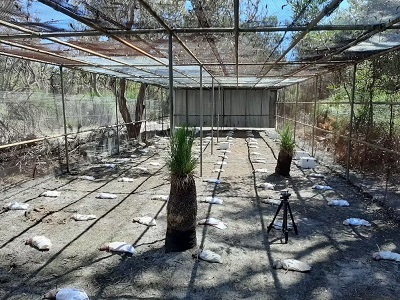
The experiment was conducted at a facility in Western Australia. Photo by Stevie Ziogos, study author
In the United States, guns are overwhelmingly the leading cause of homicides. But in countries with restricted access to firearms, such as Australia, fatal stabbings are more common.
Thus, textile analysis, including clothes and wrappings, plays a significant role in forensic investigations. Evidence could come in the form of fibers under a victim’s fingernails, tears in the clothing resulting from movement or traction, or cuts and holes caused by weapons.
But how does that analysis change if a victim is not found right away, but rather weeks or months after the homicide? How does clothing on a decomposing body react to environmental and biological factors?
That’s the question forensic experts and entomologists at Murdoch University in Australia set out to answer in their newest study, recently published in Insects.
For the experiment, the researchers used 99 stillborn piglets to simulate human remains. They wrapped the piglets in three different fabrics—cotton, synthetic and blended fabrics with standardized cuts and tears—before leaving them to decompose naturally in a bushland environment for 47 days. Six “unclothed” piglets acted as controls, with three being stabbed. The carcasses were left during the summer months, and the bodies were shielded from large scavengers, but not insects.
“While previous research has explored the impact of clothing on decomposition, we were focused on the other side of the coin: how do insects impact the fabric on a decomposing carcass? And in what ways could this jeopardize an investigation?,” said study author Paola Magni, Senior Lecturer in Forensic Science at Murdoch University.
It wasn’t long before the fabrics started to transform.
According to the study results, cuts that were associated with stabbing and then stained with biological material were affected most noticeably, especially cotton. For example, less than a week after the carcasses were placed, new holes appeared in the cotton fabric as the fibers broke down. After 46 days of exposure, most cuts could still be indicated, however gleaming blade characteristics—such as a sharp or dull knife—from the evidence would be “problematic,” the study authors said.
Insect-wise, necrophagous insects caused the fabrics to appear weathered and abraded, with significant fraying and displacement of yarns and fibers at the fabric surface, especially around cuts stained with blood. The researchers said fabric distortion could also have been caused by the movement of blow fly larvae and their mouth hooks, which assist in crawling and rasping the tissues of the piglet. Of 20 insect groups collected and identified, blowflies and carrion beetles were the most common antagonists.
Some insects, like dermestid larvae and adults, fed directly on the fabrics—causing fractures—rather than the piglet bodies. The researchers recorded this activity as fabrics “appearing with parts of holes on dry areas stained with decomposition fluid.”
Additionally, Magni and team noted new artifacts on wrappings where the decomposition fluids had leached through the fabric and had become dry, but remained in contact with the soil. They attribute this to normal, gradual biodegradation caused by bacteria and fungi, although they note that degradation was less evident at the interface between the carcass and soil.
The present study is the first time this data has been documented in such detail in a controlled experiment. Still, there is more work to do and the study authors recommend that investigators use caution when classifying cuts or tears in fabric recovered from a highly decomposed or skeletonized body.
“Focusing on unstained areas can avoid the interpretation of alterations caused by carrion insects attracted to stained areas, but is unlikely to be practical in casework. It is clear that more research is required to bolster the body of knowledge in regard to the interaction of decomposition with textiles of any type in a forensic context,” Magni and her colleagues conclude.
The research team also published guidelines to help others in the process of observing and collecting insects at a crime scene, and in considering how insect activity may be connected with a victim’s clothing.
“We hope our work can help future investigations, and maybe even reopen some cold cases,” said Magni.