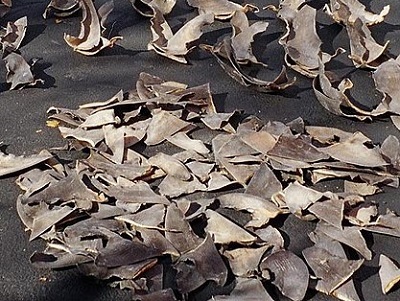
Confiscated shark fins. Credit: NOAA
Wildlife conservationists must turn crime scene investigators (CSIs) to combat the illegal trade of rare species like sharks, rays and other rare animals. That’s the view of a group of scientists specialized in finding "prints," residue and genetic material from animals killed indiscriminately by poachers and traders. It follows a new study in which illicit shark fin residues were clearly identified after simply dusting floors and surfaces in fishing landing and processing plants.
“By adopting crime scene type methods, we uncovered evidence of twice as many species in a fraction of the time and effort it would take to sample fish in the factory,” said Stefano Mariani, professor of marine conservation at Liverpool John Moores University.
Writing in the journal Conservation Letters, the researchers sequenced trace DNA fragments retrieved from dust and scraps from seven processing plants in Java, Indonesia, the world’s biggest shark landing nation.
They meta-barcoded the samples, identifying 61 shark and ray taxa, more than half of which could not be recovered from individual tissue samples collected from the same sites. More than 80% were species listed as outlawed by the Convention on International Trade in Endangered Species of Wild Fauna and Flora.
Illegal fishing, unregulated bycatch and market demand for certain products, like fins, are largely responsible for the rapid global decline of shark and ray populations. Globally, the shark fin trade is estimated to be worth up to $2 billion with fins among the most expensive seafood products, commonly retailing at $600 per kg. But controlling the trade is difficult not least because meat is routinely hidden from inspectors.
Normally, inspectors would need to find suspect parts of animals and painstakingly subsample them, which is a biased, lengthy, and cumbersome process for everyone involved. Instead, Mariani and the team decided that by just sweeping the floors and surfaces of those working environments would "capture" dust and scraps that harbored the overall diversity of animals that end up in the facilities.
“Having the ability to effectively ‘dust’ a warehouse or a boat for 'fingerprints’ is a major weapon in identifying wrongdoing and turning exploitation on a path to sustainability,” said Andhika Prasetyo, first author from the University of Salford. “It turned out that it works perfectly, it's quicker to sample, and it uncovers twice as many species, in a fraction of the time and effort.”
The team’s current activities are now focusing on making the technique fully portable so that results can be generated on-the-spot.
Republished courtesy of Liverpool John Moores University.