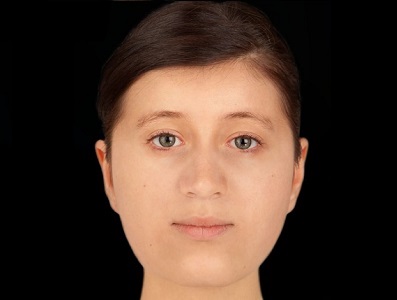
Facial reconstruction by Hew Morrison
The face of a 16-year-old woman buried near Cambridge in the 7th century with an incredibly rare gold and garnet cross (the “Trumpington Cross”) has been reconstructed following analysis of her skull.
The striking image went on public display for the first time on Wednesday, with new scientific evidence showing that she moved to England from Central Europe as a young girl, leading to an intriguing change in her diet.
The image and artifacts from the mysterious woman’s burial—discovered in 2012 by the Cambridge Archaeological Unit at Trumpington Meadows on Cambridge’s southern limits—including her famous cross, will be unveiled in a major new exhibition at Cambridge’s Museum of Archaeology and Anthropology (MAA).
“Beneath Our Feet: Archaeology of the Cambridge Region” will run from June 21, 2023 to April 14, 2024.
Forensic artist Hew Morrison created the likeness using measurements of the woman’s skull and tissue depth data for Caucasian females. Without DNA analysis, Morrison could not be sure of her precise eye and hair color, but the image offers a strong indication of her appearance shortly before she died.
“It was interesting to see her face developing. Her left eye was slightly lower, about half a centimeter, than her right eye. This would have been quite noticeable in life,” said Morrison.
A new life cut short
New “you are what you eat” isotopic analysis of the young woman’s bones and teeth—conducted by bioarchaeologists Sam Leggett and Alice Rose, and archaeologist Emma Brownlee at the University of Cambridge—also reveals that she moved to England from somewhere near the Alps, perhaps southern Germany, sometime after she turned 7 years old.
Leggett and Rose also found that once the girl had arrived in England, the proportion of protein in her diet decreased by a small but significant amount. This change occurred close to the end of her young life, showing that the period between her migration and burial near Cambridge was tragically short.
“She was quite a young girl when she moved, likely from part of southern Germany, close to the Alps, to a very flat part of England,” said Leggett, now at the University of Edinburgh.
Previous analysis indicated that the young woman had suffered from illness but her cause of death remains unknown. She was buried in a remarkable way, lying on a carved wooden bed wearing the cross, gold pins (also on display) and fine clothing.
Hers is one of only 18 bed burials ever uncovered in the UK. Her ornate cross, combining gold and garnets (third quarter of the 7th century), is one of only five of its kind ever found in Britain and identifies her as one of England’s earliest converts to Christianity and as a member of the aristocracy if not royalty. The best-known example of such a cross was found in the coffin of St. Cuthbert.
In 597 AD, the pope dispatched St. Augustine to England on a mission to convert the pagan Anglo-Saxon kings, a process that continued for many decades.
“She must have known that she was important and she had to carry that on her shoulders. Her isotopic results match those of two other women who were similarly buried on beds in this period in Cambridgeshire,” said Leggett. “So it seems that she was part of an elite group of women who probably traveled from mainland Europe, most likely Germany, in the 7th century, but they remain a bit of a mystery. Were they political brides or perhaps brides of Christ? The fact that her diet changed once she arrived in England suggests that her lifestyle may have changed quite significantly.”
In the exhibition, the “Trumpington Cross” will be displayed together with the delicate gold and garnet pins connected by a gold chain, which were found near the teenager’s neck. These pins probably secured a long veil to an outer garment of fine linen. The pins would have caught the light as she moved. The burial bed’s decorative headboard will also be exhibited.
“The story of this young woman goes to the very heart of what our exhibition is all about – new research making visible the lives of people at pivotal moments of Cambridgeshire’s history,” said Jody Joy, the exhibition’s co-curator. “MAA holds one of Britain’s most important collections of Early Medieval archaeology and the Trumpington bed burial is so important. It looks like it still has much more to teach us.”
Republished courtesy of University of Cambridge.