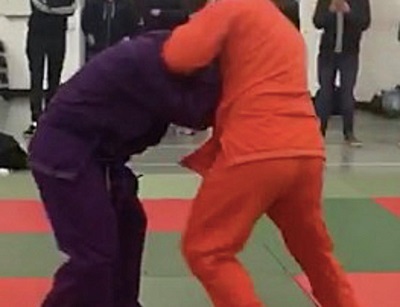
Members of Northumbria University Jiu Jitsu club staged physical assaults to help advance forensic research. Credit: https://doi.org/10.1016/j.scijus.2023.05.001
Members of a university’s jiu jitsu club recently teamed with forensic scientists to stimulate real-world assaults and fill a large knowledge gap in trace evidence.
A number of previous studies have attempted to quantitatively measure the number of fibers transferred through direct contact, such as during a physical and/or sexual assault. While the data did help in determining factors that affect fiber transfer, most were based on small-scale experiments without real people—thus, the findings did not efficiently simulate real-world circumstances.
In a new paper, forensic researchers at Northumbria University rectified that by collaborating with members of the school’s jiu jitsu club.
For the study, pairs of volunteers from the jiu jitsu team were tasked to carry out different assault scenarios, wherein one acted as an assailant (orange suit) and the other as a victim (purple suit). The assailant was tasked to adopt an aggressive, dominant, stance while the victim a more defensive, protective stance. Each simulation measured two parameters: duration (30 or 60 s) and intensity (low or high).
Altogether, four different scenarios were acted out. Each scenario was replicated five times, resulting in 20 experiments and 40 datasets.
Following each fight, the number of fibers transferred from assailant to victim and vice versa was counted via zonal taping.
Overall, according to the paper published in Science & Justice, a two-way transfer of fibers occurred between the participants in all the fights. For each way (victim to assailant or assailant to victim), the number of fibers transferred was relatively large and ranged from 1,071 to 44,613, with a mean of 13,434 and median of 6,630.
Specifically, for shorter fights, higher total fiber counts were observed on victims clothing than assailants, supporting a larger transfer of fibers from the assailant to the victim than from the victim to the assailant. The researchers found that the inverse was true in longer fights, however.
“This difference was significantly larger than that observed in any other scenario,” explain the researchers in their paper. “It is not clear why there is such a difference and further research would be needed to determine the cause. However, these results do demonstrate that preliminary information on the intensity level and duration time may be helpful in real casework to shape more accurate expectations on fiber transfer in a specific assault case.”
Fiber distribution was another part of the experiments that researchers say can better inform real casework analysis going forward.
In the study, more fibers were collected from the upper areas of the body compared with the mid/lower areas after a low intensity fight. Meanwhile, a slightly more homogeneous distribution was observed after high intensity fights. The study authors attribute this to the larger number of interpersonal contacts in high intensity fights compared with low intensity. From the perspective of real casework, this data suggests it is critical to analyze both upper and lower garments for fibers and other trace evidence.
Additionally, the researchers were able to create a correlation plot between the number of fibers sampled from each garment area. The findings supported a relatively high degree of correlation between the number of fibers collected from each area across all four scenarios.
“This suggests the possibility that, in casework, the total fiber count may be predicted based on a limited number of examined areas, if the specific relationship between them is known,” write the study authors. “This may be an interesting research perspective for future work that could potentially lead to time efficiencies in garment examination.”
With the exception of one, the fiber transfer rates recorded in this Northumbria study far exceed any others published in the literature. In fact, the quantities reported in this study are 10-fold that reported others. Additionally, the observed data spread was large, with an average relative standard deviation of 34%.