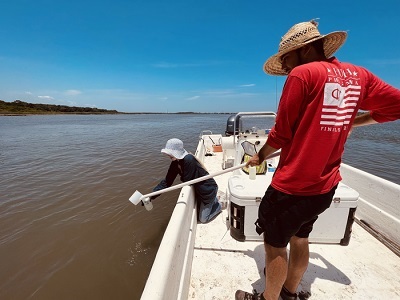
Jessica Farrell and Sean Goggin collecting water samples at Moultrie Creek, St. Augustine Florida. Credit: Todd Osbourne
A group of scientists at the University of Florida were conducting first-of-its-kind research to collect sea turtle environmental DNA (eDNA) from beach sand for conservation purposes when they kept detecting eDNA that was decidedly not marine.
The team expected some human eDNA to end up in their sea turtle samples, but the quantity was significantly more than anticipated. That gave the researchers an ethical pause—if the quality of the DNA turned out to be high, the level of personal, sensitive information that could be obtained from the sample had to be handled with extreme caution.
After gaining ethical approval from the institutional review board at the University of Florida, David Duffy, professor of wildlife disease genomics, and his team embarked on a research project to better understand inadvertent human eDNA collection and the ethical dilemmas that go along with it.
“We’ve been consistently surprised throughout this project at how much human DNA we find and the quality of that DNA,” Duffy said. “In most cases the quality is almost equivalent to if you took a sample from a person.”
Quantity and quality
In their study, published in Nature Ecology and Evolution, Duffy and team tested human eDNA recovery from a variety of water, land and air sampling sites in Florida (subtropical climate) and Ireland (temperate climate).
According to the findings, minimal human eDNA was detected in a mountain tributary of the Avoca River in Ireland above the line of human habitation. However, human eDNA was found in the same river once it neared the local town, with levels increasing as the river flowed through the center of town. Likewise, human eDNA was found in water samples taken near the city of St. Augustine, Florida, while no human eDNA was detectible from ocean water collected on an incoming tide from the ocean beyond the Matanzas Inlet in Florida.
Back on land, the researchers found no human eDNA in sand samples taken from an inaccessible area of Rattlesnake Island in Florida. By contrast, human eDNA was readily detectible from beach sand samples recovered from human footprints.
Lastly, the scientists recovered human eDNA—that matched the staff—from air samples taken from a sterile veterinary hospital. However, the team did not find human eDNA in air from rooms where no humans were present.
With quantity taken care of, the researchers set their sights on eDNA quality next. Without any enrichment, the samples of human eDNA in water, sand and room air returned thousands of human-aligning reads, while negative field control water and no-human-site sand eDNA samples had only 2 to 26 human-aligning reads.
The human eDNA data was so high-quality that the team was able to detect deletions in known human genetic variants, as well as determine the genetic ancestry of nearby populations. For example, the researchers detected seven mitochondrial mutations—six from water eDNA and one from air eDNA—that are associated with a range of diseases, including autism, diabetes, eye diseases and cardiac diseases.
For some of the samples, the scientists were even able to match the genetic information to individual participants who had volunteered to have their eDNA recovered. With the ability to potentially identify individuals, the researchers say now is the time to institute ethical guardrails.
Ethical implications
As many in the forensic field know, the advantages next-generation sequencing offers can’t be understated. In combination with its affordability and accessibility, the technological advancement has been revolutionary—for better and worse.
“Any time we make a technological advance, there are beneficial things that the technology can be used for and concerning things that the technology can be used for. It’s no different here,” Duffy said.
While ethically handled eDNA could be used to track cancer mutations from wastewater, spot undiscovered archaeological sites and diversify health databases, Duffy and team are concerned about the malicious and targeted use of eDNA.
They say the—intentional or inadvertent—capture of human eDNA could be used to unethically harvest human genomic data from local populations/ethnic groups without their knowledge or consent. The data could also be used to surveil an individual or a specific group.
“Genetic/genomic surveillance is a serious ethical concern, with documented human rights abuses having already occurred whereby national DNA databases were used with other surveillance data to monitor minority populations,” the researchers write in their paper. “The application of human eDNA approaches could further undermine genetic consent, limiting the ability of threatened minorities to withhold their genetic information.”
Malicious actors could also covertly accumulate human genetic data for commercial purposes. While pan-genomic patient datasets like the 100,000 Genomes Project and the new Genome UK Strategy are advancing medical and pharmaceutical applications, the study authors say they can be an “ethical minefield regarding ownership, data protection, insurance coverage and privacy issues.”
“[Also], examples from digital databases clearly show that wherever valuable databases exist, there is an ever-present temptation to exploit the data for financial gain, whether legally or otherwise,” reads the study.
With clear potential on both sides of the fence, Duffy says now is the time for policymakers and scientific communities to take issues around consent and privacy seriously.
“Such planning should be initiated immediately, pre-empting the technology becoming even more widespread, affordable and entrenched. Such ex-ante planning is crucial for ensuring that laws and ethics stay ahead of emerging technology,” Duffy and team conclude.