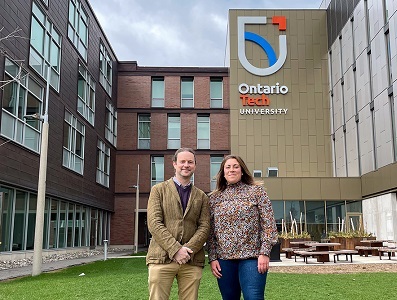
Peter Lewis and Theresa Stotesbury. Credit: Ontario Tech University
Crime scene investigations require reliable forensic science tools to make air-tight cases, eliminating any potential for ambiguity or doubt. But current methods used to interpret evidence at crime scenes have been criticized globally for subjectivity and lack of scientific rigour.
One area of criticism is the existing classification schemes of bloodstain pattern analysis (BPA), which:
- Sometimes lack clarity concerning the cause and formation of the bloodstain.
- Are not conserved as the environment varies.
- Have issues dealing with feature ambiguity.
Some branches of forensic science have modified existing schemes in response; but more recently, fundamental issues with the assumptions behind these classification schemes have been exposed.
To address these issues, an Ontario Tech University-led research team has been awarded Government of Canada Interagency research funding through the New Frontiers in Research Fund (NFRF) Exploration stream in a project titled "Reimagining forensic BPA from the bottom up."
The Ontario Tech research will be led by principal investigator Theresa Stotesbury, assistant professor of forensic science and Peter Lewis, associate professor of computer Science and Canada Research Chair in Trustworthy Artificial Intelligence (co-PI).
The project is valued at $250,000 over two years.
About the research
The team will take a data-driven approach, unburdened by the assumptions in historical schemes, to produce a bloodstain pattern analysis tool aimed at helping and guiding everyone connected to the criminal justice system in a transparent and interpretable way. The tool will be underpinned by a new classification scheme that integrates both data-driven insights and forensic expertise, and captures a more rigorous, accurate, and informed understanding of the causes of bloodstains.
The research team will use unsupervised machine learning, a family of techniques that analyzes untagged data, and facilitates the emergence of natural patterns, which may otherwise remain hidden or obscured by human bias. This approach is completely different from supervised learning, already in use in BPA, where assumptions from historical taxonomies form the basis of classification, rather than emerge from the data.
Unsupervised learning algorithms have contributed to significant advances in a wide range of disciplines from medical diagnosis to marketing, revolutionizing previous manual processes based solely on expertise, experience and intuition. A wide range bloodstain patterns from indoor and outdoor environments will examine if BPA data can enable a similar revolution in data-driven forensic science.
Republished courtesy of Ontario Tech University.