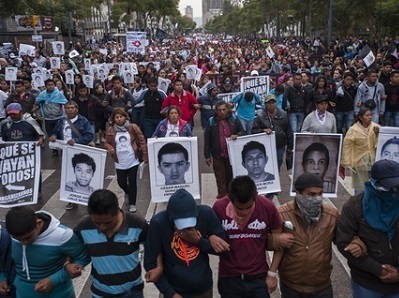
A demonstration in Mexico City after 43 students went missing from a teacher's college.
Mexico has finally published guidelines for the long-awaited National Forensic Data Bank, a database officials hope can help find and identify the more than 100,000 people registered as missing in the country.
The framework for the database was set forth in a 2017 law regarding missing persons, but those in power at the time—and in the decades prior—ignored and dismissed Mexico’s missing person epidemic. Then, in December 2018, President Andrés Manuel López Obrador assumed power, promising to make the issue a priority for his administration.
While the administration has been critical of “Western science” and thus far failed to implement the promised National Search Plan for search and rescue in missing persons investigations, they have put some resources toward the crisis. This is especially true in the famous case of 43 students who disappeared from a teacher’s college in 2014. In September 2022, Mexican authorities arrested a retired general and three other members of the army for an alleged connection to the disappearance of at least some of the students.
Still, those 43 students are included in the nearly 112,000 people missing in the country, in addition to the more than 52,000 unidentified deceased persons in mass and clandestine graves, forensic facilities and universities.
The new National Forensic Data Bank should streamline state and federal forensic data and integrate that information with records of missing people, mass and clandestine graves and unidentified bodies.
According to the guidelines published last week, the database will undergo a “gradual incorporation process” with other databases, records and systems, including:
- The National Registry of Unidentified and Unclaimed Deceased Persons
- The National Registry of Mass Graves and Clandestine Graves
- Federal Forensic Registry
- National Genetic Information Base
- National Registry of Detentions
- National Registry of the Crime of Torture
- Criminal Background Records
- The National Nominal Information System
- The Fingerprint Identification System
- The Amber Alert
- The National Registry of Missing and Unlocated Persons
- and any other database found to have forensically relevant data or information on the location and identification of missing persons.
One such database to be incorporated is the Ante Mortem and Post Mortem Database, software currently used to manage information on missing persons and human remains. This database contains everything from personal and clinical information on missing persons, to site and recovery information of skeletal remains, events related to groups of missing persons, and modules related to testimonies, research documents, relatives, evidence, etc.
According to the Attorney General of the Republic, the Ante Mortem and Post Mortem Database is expected to add 160 million datapoints to the National Forensic Data Bank once integration is complete.
The new guidelines say the person in charge of the Human Rights Specialized Prosecutor's Office—within the Attorney General of the Republic—will be tasked with supervising the implementation of the National Forensic Data Bank.
UN Committee: ‘Alarming trend’ and no impunity
Just days after Mexican authorities announced the new guidelines and database, the UN Committee on Enforced Disappearances issued a scathing report on recent trends, root causes and ongoing challenges of the crisis.
“Organized crime has become a central perpetrator of disappearance in Mexico, with varying degrees of participation, acquiescence or omission by public servants,” the committee said in the report.
The report shows disappearances continue to affect mostly men between 15 and 40 years old. However, official figures show a notable increase in disappearances of boys and girls from the age of 12, as well as of adolescents and women—a trend that worsened in the context of the COVID-19 pandemic.
Additionally, the UN Committee found that the trend of rising disappearances was facilitated by “almost absolute impunity.” As of November 2022, only a very small percentage of cases of disappearance—between 2 and 6 percent—had resulted in prosecutions, and there have been only 36 convictions handed down in cases at the national level.
“Impunity in Mexico is a structural feature that favors the reproduction and cover up of enforced disappearances and creates threats and anxiety to the victims, those defending and promoting their rights, public servants searching for the disappeared and investigating their cases, and society as a whole,” said the committee.
In its recommendations, the committee identified measures that the State party should take to implement a national policy to prevent and eradicate disappearances. It urged Mexico to strengthen the search and investigation processes, provide adequate human and financial support to the National Search Commission and local commissions, and ensure systematic and effective coordination of all institutions involved in the process of search, investigation, reparation and accompaniment to victims.
“In order for disappearance to cease to be the paradigm of the perfect crime in Mexico, prevention must be at the heart of national policy for the prevention and eradication of enforced disappearances,” the committee concluded.