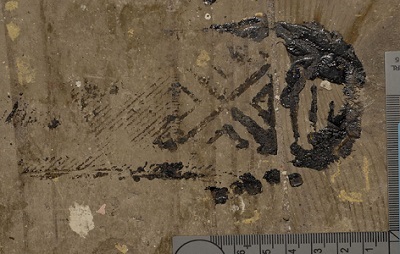
During data collection, footwear marks were deposited on different surfaces. Credit: Yorkshire and the Humber Regional Scientific Support Services (YatH RSSS)
On any given day last year, researchers from Yorkshire and the Humber Regional Scientific Support Services could be seen running at work, repeatedly turning around in one spot, kicking doors and causing general mayhem.
But the researchers weren’t upset or frustrated with their jobs, rather they were doing their jobs. In this case, they were helping with data collection to create a “ground truth database” of footwear marks to better verify evidence left by criminals at crime scenes.
“To maintain and improve reliability of results, we wanted to develop a standardized approach for ‘ground truth data’ collection so that multiple units can create and use one large dataset to support the comparison of footwear mark evidence,” said Selina Reidy, an identification expert with Yorkshire and the Humber Regional Scientific Support Services (YatH RSSS).
The YatH RSSS is a collaboration of four police forces in the Yorkshire and Humber region of the UK— Humberside, South Yorkshire, North Yorkshire and West Yorkshire Police.
The most critical part of the database was ensuring the results mimic the real world as much as possible, including challenges experts have seen in casework. In footwear mark evidence, this includes partial marks, type of substance the mark was made in, and distortions that affect the quality of marks.
This is where the expert staff members of YatH RSSS came into play.
As part of data collection, participants with a range of shoe sizes were asked to repeatedly walk the same route each day to show the progression of wear from brand new to worn out footwear. Footwear selection was purposeful—with the study focusing on footwear most frequently worn by detainees in custody as well as the most commonly identified tread patterns found at crime scenes, according to the National Footwear Database.
To aid the creation of marks showing movement, participants were asked to turn on the spot to create twisting marks, which are often observed on windowsills. They were also asked to kick a surface to replicate footwear marks seen at the point of entry, particularly if a door has been kicked to gain access.
The study also captured footwear marks as deposited on different surfaces, including wood effect laminate flooring, a wheelie bin, paper and a uPVC windowsill. Different substances were used to replicate footmarks made in dirt, dust and mud.
All footwear marks were recorded, analyzed and cataloged to create a database that YatH RSSS can now use to carry out research and support evidential comparisons. Given the project’s success, the study authors said they hope the database will serve as a toolkit for other police forces in the UK.
“This study provides a blueprint for a national approach to ground truth data collection for footwear mark evidence. The method is not prescriptive but may be used as a guide and can be adapted to meet the requirements of a forensic unit’s jurisdiction or to address gaps in an existing dataset,” said Reidy.