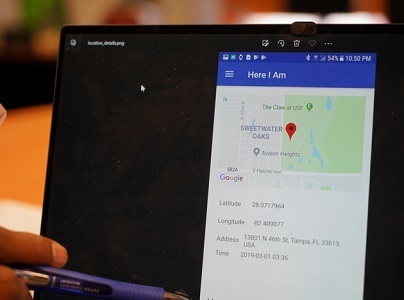
The Here I Am app, developed by two University of South Florida researchers, can accurately confirm an individual’s identity and location using their voice, creating a digital alibi. Credit: University of South Florida
If you have a map app and location services enabled on your phone, it pretty much knows where you are 24/7/365. Well, it knows where it is—not necessarily you.
That’s a problem when it comes to alibis for law enforcement. Confirming a personal device was in a specific place at a specific time is easy, confirming that the owner of said device was also there is not as easy.
After years of research, computer science experts Sriram Chellappan and Balaji Padmanabhan concluded the most efficient way to overcome this hurdle would be to combine a person’s voice with the location, date and time—a foolproof way for someone to prove they were at a specific place at a certain time.
“When law enforcement is investigating a crime, it is very common for those who are detained to be unable to generate verifiable alibis and that becomes a critical liability,” said Chellappan. “They can’t return to work, may lose their job and as a result, lose their income. I thought there must be a way to fix this and prove people’s true location, when needed.”
Chellappan and Padmanabhan’s collaboration resulted in a patented technology called “Here I Am,” which creates an unforgeable, encrypted digital certificate on a user’s cellular device. The University of South Florida professors are currently in the process of licensing the technology.
“Most location authentication technologies today mainly authenticate a device, such as a phone, but not the user. Nothing like this exists,” said Padmanabhan. “If companies with reliable location identification can offer this as a service, then individual users can easily generate their own authentication as needed.”
In the prototype, a Here I Am user initiates a request to generate an authentication certificate. The user is then prompted to read a message out loud. While reading, the user’s device will record their voice, which is paired by a server with the date, time and precise location data to create a cryptographically verifiable certificate that forever preserves the information on the user’s device.
The researchers created three categories of use for the technology:
- Solo, where an individual voluntarily chooses to authenticate themselves
- Parent-child, where the “parent,” such as an organization, sends a notification to their employee, the “child,” to authenticate themselves; and
- Ambient, where a user elects to have it automatically authenticate their location every few minutes.
While Chellappan spent the last several years brainstorming inventions to protect people from being wrongly accused of crimes, the resulting technology holds a variety of purposes beyond alibis. For example, ride-share companies can use it to validate users and locations, protecting both riders and drivers. Meanwhile, financial institutions can use the technology as an additional layer of security for account owners when approving money transfers.
Importantly, the researchers say the technology can also be used to protect victims of domestic abuse.
The goal is to license the technology directly to telecom providers that utilize location data. The providers can then offer it to companies to integrate into their own apps.
“The demand to certifiably authenticate a person or an asset at a particular location at any point in time has immense value, that is yet to see the dawn of day,” said Chellappan. “Our technology enables just that and could be a game changer to the immense diversity of practical applications.”