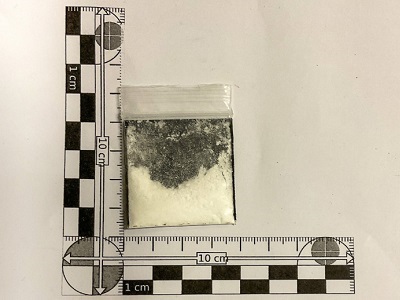
Sample of the new drug provided for testing to CanTEST. Credit: Malcom McLeod
Scientists working with Australia's first fixed pill testing site have detected a mysterious new recreational drug not seen in the country before, nor toxicologically described anywhere else.
The scientists, from Australian National University (ANU), have named the drug “CanKet,” as it shares similar chemical qualities to ketamine, but has a unique makeup previously unseen.
CanTEST, Australia's first fixed pill testing site, was launched in Canberra in July as a six-month pilot after successful smaller-scale pill testing operations at music festivals throughout the country. Users of the service can present drugs for on-site analysis, and access information and advice from harm reduction workers based on the analytical results they receive. The service is a collaboration multiple health agencies in Australia, with testing and advice provided by scientists from ANU.
Recently, someone presented a small plastic bag of crystals and powder to the testing service.
"They told us that they thought it was ketamine but that the effects of the drug were very different to what they expected, so they wanted us to test it,” explained Malcolm McLeod, associate professor at ANU and chemistry lead for CanTEST.
When McLeod’s team tested the substance, it became clear it was not ketamine, but rather a ketamine-like substance. Hence, the name CanKet—as in Canberra ketamine.
"Our initial reaction was 'whoa, this is really weird'. We have no idea who made the drug and where it came from,” said McLeod.
Ketamine is a dissociative anesthetic used medically for induction and maintenance of anesthesia. Clinically, it is one of the safest anesthetics and is simple to administer, making it a common choice. When used recreationally, ketamine, or “Special K,” produces a dissociative state, characterized by a sense of detachment from one's physical body. At sufficiently high doses, users may experience what is called the "K-hole," a state of dissociation with visual and auditory hallucination.
While researchers now have a clear read out of the chemical structure of CanKet, they are still unsure of the drug’s exact effects.
"While it would be fair to say we understand ketamine very well as a drug, we literally have no other data as to what the acute or chronic effects of this close cousin might be, and that is disconcerting. Assuming that it is 'safe' because it appears related to ketamine would be an error of judgement,” said McLeod. “[Even though] we don't know all the effects of this particular drug just yet, we can give people a clearer idea of the likely effects, based on the chemical makeup it has and advise them accordingly."
That expert advice is the entire point of CanTEST. Throughout August and September, CanTEST tested over 150 samples and, out of those, 34 were discarded once the owner knew the contents of the drug—which were presumably different than they thought walking into the service.
“We are engaging with a new generation of young consumers, many of whom have never sought advice on their drug consumption before now. For some, those decisions involve choosing not to consume the drugs that that they have volunteered to have tested. For others, they may choose to use their drugs in a way that makes them less likely to be harmed,” said McLeod.
Overall, most samples presented have contained the expected drug, but there are notable exceptions.
For example, one of the ketamine samples presented for testing in August was shown to contain no ketamine at all, but rather an unknown substance. Later laboratory analysis by ANU researchers determined the drug to be fluorexetamine, a ketamine derivative for which there is almost no scientific information available.
In 19 expected cocaine samples, four did not contain the drug, with two lacking cocaine entirely. In one of those samples, researchers detected the relatively benign crystalline substance, dimethyl sulfone—an organic compound containing sulphur. In the second sample, the researchers found methamphetamine instead of the expected cocaine.
In sharp contrast to the United States, fentanyl was not expected or detected in any of the samples.
The scientists said their research into CanKET will continue.
"This is why services like CanTEST are so invaluable,” said McLeod. “It allows us to identify never-before-seen drugs, as well as common drugs, and provide people who use the service clear guidance on the likely health and other effects of these drugs. This can potentially save lives.”