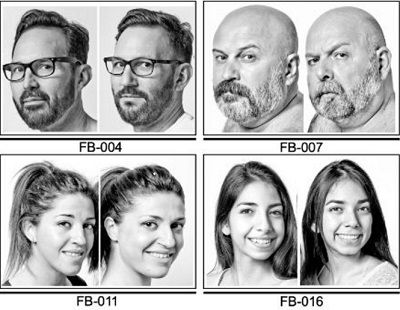
Photographic examples of look-alike used in the study. Credit: François Brunelle
In perhaps one of the more unique datasets in science, a team of researchers from Spain has shown that unrelated people who have look-alikes share not only strong facial similarity but genetic variants as well.
“Doppelgängers” have long been of interest, appearing in a multitude of ways in pop culture throughout the years. But, the number of people identified as unrelated doppelgängers has exponentially increased with the internet and the explosion of social media and public photo sharing.
In a new study, researchers at the Josep Carreras Leukaemia Research Institute in Barcelona and colleagues set out to characterize—on a molecular level—these doppelgängers.
To do so, they recruited 32 human doubles from the photographic work of François Brunelle, a Canadian artist who has been obtaining worldwide pictures of lookalikes since 1999. First, all participants completed a comprehensive lifestyle and biometric questionnaire, and provided saliva for multiomics analysis.
Then, the research team ran three different facial recognition programs to determine the degree of “likeness” in each couple. The number of pairs considered to be correlated by at least two programs was very high—75%, or 25 out of 32. In all three programs, correlation was found in 16 out of the 32 couples. These couples then formed the basis of additional DNA research.
According to the paper published in Cell Reports, genome-wide analyses for common genetic variations and their epigenetic profiles were carried out on saliva DNA samples, together with microbiome analysis.
The genetic analysis revealed that 9 of the 16 pairs had 19,277 common single-nucleotide polymorphisms (SNPs). Among these 16 pairs, many had similar weights, and analysis of their biometric and lifestyle factors also showed that there were similarities.
Additionally, physical traits such as weight and height, as well as behavioral traits such as smoking and education, were correlated in look-alike pairs. Taken together, the researchers say these results suggest that shared genetic variation not only relates to similar physical appearance, but may also influence common habits and behavior.
“Our study provides a rare insight into human likeness by showing that people with extreme lookalike faces share common genotypes, whereas they are discordant at the epigenome and microbiome levels,” said senior author Manel Esteller of the Josep Carreras Leukaemia Research Institute. “Genomics clusters them together, and the rest sets them apart.”
A few study limitations of the study include the small sample size, the use of 2D black-and-white images, and the predominance of European participants. Despite these caveats, the researchers say they are looking forward to how the findings can apply to future applications.
“Our findings provide a molecular basis for future applications in fields such as biomedicine, evolution, and forensics,” said Esteller. “It would be very interesting to follow up the potential application in forensics, using the genome of unknown people to prepare bioinformatic strategies to reconstruct the face from DNA. And in medicine, we may be able to deduce the genome of a person from facial analysis and hence use this as a pre-screening tool to detect the presence of genetic mutations associated with disease and apply preventive strategies at an early stage.”
Although the study’s sample size was small, the research team does not expect the results to change in a larger group. What they do hope will happen when applied to a larger cohort is the reveal of more genetic variants shared between doppelgängers.
“Through collaborative efforts, the ultimate challenge would be to predict the human face structure based on the individual’s multiomics landscape,” said Esteller.