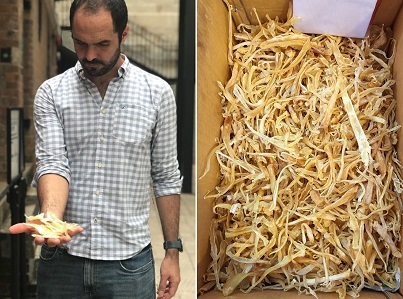
FIU postdoctoral researcher Diego Cardeñosa with shark fin trimmings. Credit: Stan Shea
Off the coast of Colombia, the intersection between forensic science and environmental conservation meet. Diego Cardeñosa, an FIU researcher and Distinguished Postdoctoral Scholar, installed in-port DNA detection tools that help provide proof of wildlife poaching in the region.
His groundbreaking work recently earned him a Directorate of Criminal Investigation and Interpol (DIJIN) medal from the global agency. The award came days after another achievement: the publication of a study led by Cardeñosa that used DNA detective work to uncover that two-thirds of species in the global shark fin trade are threatened with extinction.
A lifelong shark lover, Cardeñosa wanted to study the giant predators from a very early age.
“Sharks have always been my passion,” he explained. “Wildlife trade issues came along later in my career. I am very dedicated to it given that it is one of the largest global threats to biodiversity, and we need to disrupt it if we want to save the species that are in danger by this illicit trade in our planet.”
According to INTERPOL’s Global Fisheries Enforcement team, illegal fishing can not only disrupt the local ecosystem but can be symptomatic of other illicit activities, including human trafficking and drug trade.
In collaboration with DIJIN, Cardeñosa developed protocols and tools to help local law enforcement agencies in Latin America, especially in Colombia, track, detect and, in some cases, stop illegal shark and freshwater turtle trade in a matter of hours. Using DNA, he can determine if a shipment of steaks is a shark, or even if a turtle came from a specific protected region. In many cases, there is enough evidence to prosecute the case.
“The in-port DNA tool allows them to get over that identification challenge and know if a crime is committed quickly," he said. "That part is key since, if they do not have the evidence on a timely manner, the case cannot move forward, and the crime goes unnoticed or unprocessed.”
He added, “This recognition by DIJIN in Colombia was incredible. As a Colombian scientist, receiving this recognition by institutions in your country is an honor and it definitely fuels my drive to keep fighting and create positive change to biodiversity and society through my work."
FIU uniquely positioned him to match his love for wildlife with a new passion to save them.
“Working with my colleagues at the College for Arts and Science and Education and the Global Forensic and Justice Center, I have been able to develop novel ideas and explore different avenues to solve some of these pressing issues.”
The issue of wildlife poaching is far from unique to Latin America. Cardeñosa is looking forward to bringing these tools and technology to other wildlife and trafficking hubs around the world, not just sharks.
He’s already working in Hong Kong, Peru, Spain, Colombia, Ecuador, Seaflower Biosphere Reserve in the Caribbean Sea, Guyana and Indonesia to conduct research and protect the world’s oceans from the most dangerous animal: man.
Risk of extinction
In July, Cardeñosa was the lead author of a research paper published in Conservation Letters, that revealed more than 70 percent of species that end up in the global shark fin trade are at risk of extinction—and sharks living closer to our coastlines might be of greatest conservation concern.
Scientists from the U.S. and China sampled 9,820 fin trimmings from markets in Hong Kong — one of the largest shark fin trade hubs in the world. With a little DNA detective work, they unraveled the mystery of which fins belonged to what shark species. In total, they found 86 different species. Sixty-one of those, more than two-thirds, are threatened with extinction.
“Overfishing is most likely the immediate cause of the declining trends we are seeing in shark and ray populations around the world,” said Cardeñosa. “The fact that we are finding so many species threatened with extinction in the global shark fin trade is a warning sign telling us that international trade might be a main driver of unsustainable fishing.”
The International Union for the Conservation of Nature (IUCN) Red List of Threatened Species assessed sharks — and their relatives, the rays and chimeras — in 2021 and found about one third of all species were threatened. Results of this new study indicate species in this trade are much more likely to be in threatened categories.
For nearly a decade, Demian Chapman—Director of the Sharks & Rays Conservation Program at Mote Marine Laboratory & Aquarium and Adjunct Professor at FIU—has led the collaborative team, that includes Cardeñosa, to track and monitor the global shark fin trade.
To date, they’ve conducted DNA testing on about 10,000 small scraps taken from processed imported fins, sold in markets in Hong Kong and South China. The project is in collaboration with BLOOM Association Hong Kong and Kadoorie Farm & Botanic Garden. The team’s goal is to better understand what species are in the trade and how common they are. By tracking this over time, they will be able to inform decision-makers about how well various management measures are working.
The study found the common species that end up in the fin trade are open ocean, or pelagic sharks, like the blue and silky sharks. However, the greatest number of species in the trade live in coastal areas, including blacktip, dusky, spinner and sandbar sharks. The researchers warn without management many of coastal species could become extinct. Three coastal species are already thought to be extinct — all in nations that did not regulate shark fishing.
“A few nations are protecting or sustainably fishing sharks and their relatives, but the majority are not for a variety of reasons” Chapman said. “Quite a few of the coastal sharks we found in the trade—such as smalltail, broadfin, whitecheek and various hound shark, river shark and small hammerhead species — are listed as Endangered or Critically Endangered and yet there are no regulations protecting them anywhere in their range. Unless the relevant governments respond with management soon, we are likely to experience a wave of extinctions among coastal sharks and rays.”
Republished courtesy of FIU.