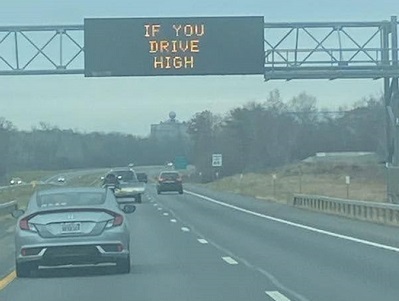
Credit: Journal of Studies on Alcohol and Drugs/Rutgers Center of Alcohol & Substance Use Studies
States that legalized recreational marijuana saw a subsequent increase in traffic crashes and fatalities, according to a new study published in the Journal of Studies on Alcohol and Drugs. However, the study is only correlational, but does hint at the scientific need to quantify the use of cannabis in terms of amount, but also the implications it has on actions such as driving.
“Studies looking for a direct causal link between marijuana use and crash risk have been inconclusive,” said lead researcher Charles Farmer, Ph.D., of the Insurance Institute for Highway Safety. “Unlike alcohol, there is no good objective measure of just how impaired a marijuana user has become. Until we can accurately measure marijuana impairment, we won’t be able to link it to crash risk.”
For the study, Farmer and colleagues compared five states that enacted recreational use of marijuana for adults age 21 and older—Colorado, Washington, Oregon, California and Nevada—with six states that did not—Arizona, Idaho, Montana, New Mexico, Utah and Wyoming.
Using data on crashes and traffic volume for 2009 to 2019 from the Federal Highway Administration, the authors found a 5.8% increase in the rate of traffic crash injuries and a 4.1% increase in fatal crash rates between states that legalized recreational use of cannabis and those that did not.
But, the injury crash rates varied by state.
Colorado, for example, experienced the biggest jump at +17.8%, and California the smallest (+5.7%) after both legalization and the onset of retail sales. Meanwhile, Nevada’s rate decreased (-6.7%). The researchers found no increase during the same time in the states that did not legalize cannabis. The authors adjusted for factors known to contribute to crashes and fatalities, including seat belt use and unemployment rate.
Overall, the initial jump in the injury crash rate occurred after legalization but before retail sales began. Average traffic crash injuries rose 6.5% after legalization but decreased slightly (-0.7%) after retail sales commenced.
“Legalization removes the stigma of marijuana use, while the onset of retail sales merely increases access,” said Farmer. “But access to marijuana isn’t difficult, even in places without retail sales. Users who previously avoided driving high may feel that it’s okay after legalization.”
However, fatal crash rates increased both after legalization (+2.3%) and after retail sales were authorized (+1.8%). Increases occurred in Colorado (+1.4%) and Oregon (3.8%), but decreases were found in Washington (-1.9%), California (-7.6%) and Nevada (-9.8%).
The study authors say the sharper relationship between marijuana legalization and traffic crash injuries—rather than fatalities—may be due to how some drivers compensate when impaired by cannabis.
Earlier studies involving driving simulators have shown cannabis use to affect reaction time. And indeed, drivers impaired by the influence of marijuana are thought to slow down and maintain a larger distance between themselves and other vehicles. Impaired drivers driving at lower speeds may not be able to avoid a crash—but the low-speed crashes that do occur may be less likely to be deadly.