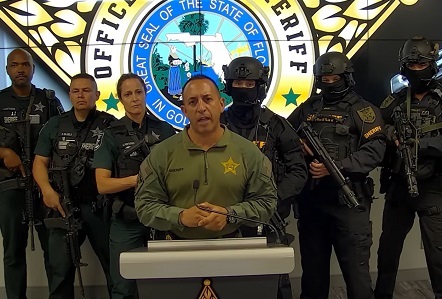
Lee County Sheriff Carmine Marceno and team members announcing a “safe schools” initiative last week. Credit: Lee County Sheriff’s Office YouTube.
In an unusual move, law enforcement in Florida released the name and image of a 10-year-old boy who was arrested over the weekend and charged with making a written threat to conduct a mass shooting.
Typically, law enforcement does not identify or release the images of minors that are arrested. In this case, the Lee County Sheriff’s Office used their Facebook to identify the boy by name, his date of birth and show video of him being escorted to a squad car in handcuffs.
According to Lee County Sheriff Carmine Marceno, investigators learned of a threatening text message sent by the boy, who is a fifth grader at an elementary school in Cape Coral, to his friend. In the text messages, the boy allegedly shared Google images of money and four assault rifles, and directly referenced a specific school-sponsored event.
The text message threats were forwarded to deputies by a tipster on Saturday, May 28. Marceno said the school threat enforcement team was notified and began analytical research on the threat. By that evening, the Lee County Sheriff’s Office had the boy in custody, interviewed him and developed probable cause for his arrest. He was charged with making a written threat to conduct a mass shooting.
At 7:32 p.m. local time on Saturday, the Lee County Sheriff’s Office published their Facebook post identifying the boy with an embedded YouTube video of him being escorted to a squad car while handcuffed.
“This student’s behavior is sickening, especially after the recent tragedy in Uvalde, Texas,” said Marceno. “Right now is not the time to act like a little delinquent. It’s not funny. This child made a fake threat, and now he’s experiencing real consequences.”
Still, the decision to release the boy’s information is an unusual one as it deviates from status quo and, for the most part, is not being repeated. The Associated Press said it is not naming the minor as per policy, and mainstream media is following suit. For example, Fox News interviewed Marceno early this morning and showed the 23-second YouTube video, but blurred the boy’s face as the footage was replayed.
Both the timing of the threat and release of the boy’s name and image raise interesting questions regarding arrestees of all ages.
While Marceno did not explicitly state the decision to identify the minor had to do with the nature of a school shooting threat just days after the deadliest school shooting in U.S. history, it’s not a far leap. So the question becomes, if this happened days before the Uvalde tragedy, or even 1 year after it, would Marceno and the Lee County Sheriff’s Office still have released the boy’s information?
Previous actions would indicate yes. For example, in October 2021, the Lee County Sheriff’s Office identified a 7th grader after he posted a threat to commit a shooting on social media. The police charged him with threat to conduct a mass shooting, and released his mugshot.
In Florida as in most states, juvenile delinquency records are automatically destroyed at age 21. However, there are some exceptions, including if the juvenile is sent to a juvenile prison or correctional facility. If that occurs, the juvenile delinquency records are destroyed at age 26 instead. If the 10-year-old boy in this case does not turn into a habitual juvenile offender after this arrest, his legal record will be destroyed at some point in his 20s. His Google record will live on, though.
Beyond age, the act of releasing information about an arrestee and even those convicted of a crime is not a new controversy. Some people believe coverage of a person’s crimes only makes others want their “15 seconds of fame,” while some believe it is in the public’s best interest to be informed.
Interestingly, some police departments have already stopped naming suspects in cold cases. For example, even though the Indiana State Police (ISP) identified Harry Edward Greenwell as the so-called I-65 killer in April, they chose not to show his mugshot during a subsequent press release as to not “glamorize” him or his crimes. A visibly choked up Doug Carter, ISP superintendent, refused to even say Greenwell’s name during the conference.
On the other hand, when Richmond police identified Jerry Lee Henderson as the man who murdered 28-year-old Meekiah Wadley in her home in 1999, Acting Richmond Police Chief Louie Tirona did not want to name Henderson publicly. However, Tirona relented after he received pushback from Wadley’s family, who said the killer’s family still considered him a good person.