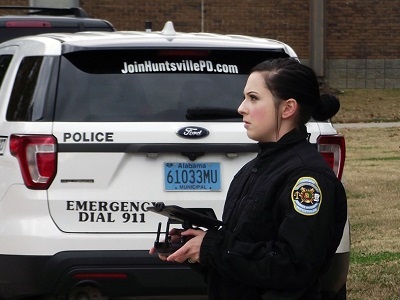
An HSVPD patrol officer/drone pilot. Credit: HSVPD/Autel Robotics
Drones have become increasingly popular tools for law enforcement departments across the country. Huntsville, Alabama is one such place, with a very successful drone program that was implemented with careful planning and support from city leaders. The program is increasing in size and scope, and the successes are attracting attention from neighboring agencies.
Huntsville, with a population of 216,000, prides itself on being a “technology-driven” city, and has been for much of its history. In fact, Huntsville was one of the early homes of the U.S. rocketry programs, earning it the nickname “The Rocket City.”
Intentional beginnings
Huntsville Police Department (HSVPD) first started considering drones in 2017. The department was looking for drones that could support officers with real-time intelligence, as well as collecting forensic and crime scene information. In early 2019, HSVPD decided on the Autel Evo II platform for its new drone program.
Unlike some other drone programs around the country, this one had support from city leaders and other stakeholders. While many programs start from the ground up, often with pilots bringing in drones they personally own, Huntsville very intentionally developed a plan for the drone program long before purchasing the actual equipment.
The police department took about a year to develop and fine tune their plan and training, with support from the police chief and city leaders. This helped HSVPD determine mission roles and other important information, allowing the department to make the most informed decisions possible.
Ultimately, HSVPD landed on an approach they call “patrol-embedded,” which uses patrol officers as drone pilots working across all precincts. The approach was highly effective for several reasons.
“These officers can respond to an event in precinct in under 5 to 10 minutes, or are on scene anyway as part of their patrol duties,” said Chad Tillman of Huntsville PD. “We have also found that this model takes advantage of the officer’s knowledge of the area and each precinct’s unique needs.”
A program that works
The drone program quickly proved its worth.
“Our first operation year, we flew a little over 300 flights with 9 pilots. Last year, we flew 1,500 plus flights,” said Tillman. “We are able to provide major support to traffic investigation, drug interdiction, and special teams. It is still work to help everyone understand how this resource can benefit day-to-day operations, but I am really amazed at the breadth of mission types we are now flying. For example, with traffic investigations, the traffic homicide investigator usually does not have to wait for a pilot—they are already on scene.”
In general, drone use has increased about 300 percent per year, and they’ve played a vital role in a wide range of police missions.
In 2021, HSVPD flew drones 1,241 times for a total of 273 flight hours. Currently, the department has 16 Autel EVO IIs and two Brinc Lemurs S drones. They also added 16 pilots to their roster for a total of 21 pilots and 7 in reserve.
“About 80% of our mission support flights are rated ‘positive effect on mission outcome,’ with 25% rated ‘critical to mission success,” said Tillman.
HSVPD’s drones also have helpful add-ons, such as the ability to stream information real-time to share with officers in the field, command teams and other agencies.
What’s next?
HSVPD plans to continue training officers, establishing command and control infrastructure, and coordinating with other departments.
“We are going to continue with the embedded program. We are also adding trained visual observers,” said Tillman. “This is being done by offering a class each quarter to train 20 to 25 VOs. Additionally, we are going to add a minimum of six pilots a year. We will also be training senior pilots to function as drone ops officers and drone traffic management. We are building out a drone support vehicle and hope to be able to add a dedicated van in the future.”
The budget is an ongoing consideration, though HSVPD has been proving the program’s worth. So much so that the program’s success has garnered interest from neighboring agencies, with Tillman confirming HVSPD is now providing mutual aid to departments close by.
“We are also beginning a statewide small unmanned aircraft system (sUAS) working group that focuses on law enforcement sUAS use. This will be used to bring state agencies together to discuss, train, and plan sUAS programs and usage,” concluded Tillman.