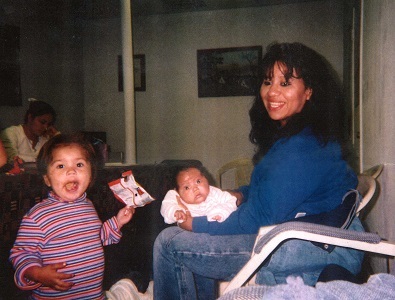
Lucio with family. Credit: The Lucio Family via the Innocence Project.
In an increasingly rare show of unification, 83 bipartisan Texas representatives—comprising the majority of members in the Texas House of Representatives—have signed a letter to Governor Greg Abbott urging clemency for Melissa Lucio, who is scheduled to be executed on April 27, 2022. Lucio is awaiting execution for the death of her young daughter, Mariah.
“There’s simply too much doubt about whether Melissa Lucio is guilty, or even whether a crime occurred in the first place,” said state representative Jeff Leach (R-Plano), co-chair of the House’s bipartisan Criminal Justice Reform Caucus. “She was convicted based on discredited forensics and the testimony of a medical examiner who didn’t follow protocol and put another innocent person in prison just two months after [Lucio].”
This letter comes just a week after attorneys for Lucio submitted an application for clemency based on new evidence the jury did not hear in the initial trial.
According to the Innocence Project, “the clemency application includes the declarations of seven nationally recognized experts, including scientists and forensic specialists, who have reviewed the evidence and concluded that [Lucio’s] conviction was based upon: (1) an unreliable ‘confession’ that is essentially a mere ‘regurgitation’ of facts and words officers fed to her during the 5-hour interrogation, and (2) unscientific, false evidence that misled the jury into believing that Mariah must have been killed by physical abuse, when the evidence is actually consistent with a conclusion that Mariah died from medical complications after a fall. The application also documents that Lucio asserted her innocence more than 100 times over five hours of the interrogation.
Mariah’s death
On Feb. 15, 2007, as Lucio was moving her family to a new home, Mariah fell down a steep outdoor staircase leading to their apartment. After the fall, Mariah’s injuries did not appear life-threatening, but two days later she fell asleep on her parents’ bed and did not wake up. Mariah had physical disabilities that made her walking unstable and she had a history of falls, including a recent fall at a preschool program where she lost consciousness.
Two hours after Mariah’s death, Lucio was questioned by male police officers at the precinct for over 5 hours. At the time of her arrest, Lucio had no history of abusing her children or violence of any kind. She was also pregnant with twins. After hours of continuous interrogation, around 3:00 am, Lucio “confessed” to murdering her daughter.
The new application filed by Lucio’s attorneys says she was especially vulnerable to the aggressive tactics of the male police as a victim of sexual abuse and domestic violence, as well as low IQ, and abnormally high levels of suggestibility and compliance.
David Thompson and Gisli Gudjonsson, experts on interrogation and false confessions, respectively, analyzed Lucio’s interrogation and concluded that her admissions are “unreliable” and simply a “regurgitation” of the words and facts that interrogators fed to her throughout a highly coercive interrogation process.
At the time, the Cameron County District Attorney Armando Villalobos was vehement that Lucio confessed to the murder during that interrogation. Villalobos is now serving a 13-year federal sentence for bribery and extortion.
Autopsy concerns and forensic expert opinions
The most recent application for clemency says Norma Farley, Texas’s state medical examiner at the time of Mariah’s death, was told pre-autopsy that Lucio had confessed to abusing Mariah. During the autopsy, Farley was joined by two of the interrogating officers.
“[Farley] assumed everything she observed was evidence of abuse and ignored all evidence to the contrary,” reads the application.
Janice Ophoven, a pediatric forensic pathologist who is one of seven experts to review the case evidence, agrees that Farley was biased by information presented to her, and failed to look at alternatives beyond abuse.
“[Farley] failed to review any of Mariah’s medical history to look for any explanation or contributing cause to her injuries, conduct any basic laboratory tests to diagnose a coagulation disorder, or even perform simple testing to confirm the presence of infection or sepsis,” stated Ophoven.
Both Ophoven and Michael Laposata, the chairman of the Department of Pathology at the University of Texas Medical Branch at Galveston, agree Mariah was suffering from disseminated intravascular coagulation (DIC), a disorder that causes extensive bruising following a head trauma—like the injury that Mariah suffered from her fall.
“In patients with DIC, routine handling at home or in a hospital setting can cause significant bruising. It is not possible to tell the difference between a bruise from DIC and a bruise from abuse,” Laposata stated in his declaration.
However, Farley testified to the opposite at Lucio’s initial trial.
“At Lucio’s trial, the jury was told that Mariah’s injuries could only be explained by child abuse and complications from an accidental fall were impossible. That testimony was false. Farley failed in her duty to rule out nonviolent medical explanations for Mariah’s condition before rushing to agree with law enforcement’s judgment of abuse,” reads the clemency application.
Four jurors who served on the jury that sentenced Lucio to die and one alternate juror have expressed concerns about the evidence they were not allowed to hear, especially the fact that Mariah’s cause of death cannot be pinpointed, and has a viable alternative medical explanation.
“I think if I heard this evidence I may have decided differently,” said juror Alejandro Saldivar.
Lucio’s other children are urging the governor and the board not to execute their mother. They are Mariah’s brothers and sisters and Texas law requires that their wishes be taken into account.
“I think the whole system failed [Lucio] every step of the way,” said Lacey Hull (R–Houston). “CPS didn’t adequately intervene after numerous reports Melissa was being abused by her husband, a corrupt DA who’s now in prison pushed this prosecution for pollical reasons, and [Lucio’s] husband, who had a violent history, got only four years in prison while she got a death sentence. What happened here is wrong.”
The initial recommendation for clemency will be in the hands of the Board of Pardons and Paroles, but must then be approved by the governor of Texas.
The Innocence Project contributed to this article.