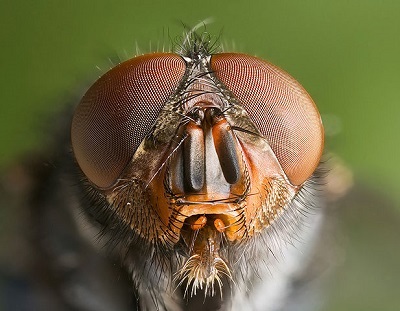
Close-up of the head of Calliphora vomitoria. Credit: JJ Harrison
Forensic experts have long studied blow flies due to their connection—or perhaps inclination—to dead bodies. Over the years, research on blow fly growth rates, decomposition patterns in different environments and even the use of flies to clean wounds has gained momentum.
Now, in the midst of a war in Europe, forensic and chemical researchers at Indiana University (IUPUI) have discovered another way to utilize blow flies—as chemical sensors with a focus on the detection of chemical warfare agents.
Despite widespread bans, chemical weapons have been deployed in recent conflicts such as the Syrian civil war, and some experts fear they may be used in Russia’s war against Ukraine. If that happens, IUPUI researchers say blow flies could be “sent in” to investigate the use and aftermath of these weapons, keeping humans out of potentially dangerous situations.
“If an area is too dangerous, too remote or in an access-restricted area—or if one just wanted to collect samples covertly—then one just needs to put out some bait and the flies will come to the bait," said project leader Nick Manicke, an associate professor of chemistry and forensic and investigative sciences at IUPUI. "We can scan through big areas by drawing the flies into a trap and analyzing what is in their guts."
For the study, published in Environmental Science & Technology, the research team used a chemical weapon simulant that shares features of actual chemical warfare agents, but is not poisonous to people. They also used pesticides, which are chemically similar to chemical warfare agents in terms of their molecules' behavior.
After baiting the flies to interact with the simulated environment, the team waited 14 days to analyze the fly’s guts for any indication of the chemical stimulants they flew through and absorbed. Using a mass spectrometer, the researchers were able to detect the chemical warfare agent simulants as well as some of the molecules chemical agents get broken down into once they're in the environment.
“If a fly were to come across a water source with a chemical agent hydrolyzed in the water, we would find that in the fly,” said Manicke.
While this stage of the blow fly research was funded through a contract with the U.S. Defense Advanced Research Projects Agency (DARPA), the Army Research Office on Environmental Chemistry will help fund the next steps.
Manicke and his team are now working on a new two-year project that focuses on the detection of molecules from insensitive munitions—a new type of explosive compounds that are less likely to detonate by accident. Because of this, however, they tend to deposit more in the environment. Using blow flies from areas that are remote or dangerous, the researchers will look for traces of insensitive munition compounds in the flies, indicating environmental contamination.
Both stages of the research also have important applications for environmental scientists who want to understand how pollutants, such as pesticides, move through and accumulate in the environment.