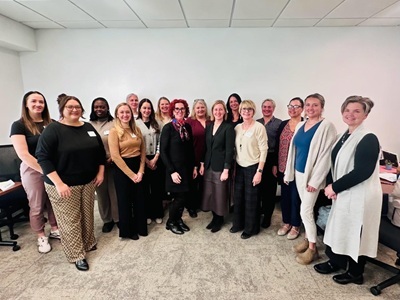
A group of forensic nurses gathered for the first Forensic Nursing Leadership Collaborative, a leadership development program run by the Sexual Assault Forensic Examination Telehealth Center in the Ross and Carol Nese College of Nursing. Credit: Penn State.
Twelve forensic nurses from across the country gathered at Penn State Oct. 23-25 as the first cohort of the Forensic Nursing Leadership Collaborative (FNLC), a new leadership development program run by the Sexual Assault Forensic Examination Telehealth (SAFE-T) Center in the Ross and Carol Nese College of Nursing.
The FNLC was created to cultivate the next generation of forensic nurse leaders, helping them develop the skills to build and sustain forensic nursing programs, better prepare clinical teams and expand access to expert care.
The inaugural cohort consisted of experienced forensic nurses who are early in their leadership careers, including those entering formal leadership roles and others already serving as informal leaders. During the three-day training, fellows worked on plans to address challenges in their hospitals and communities, including workforce development, nursing education, multidisciplinary coordination and access to forensic care in rural areas.
“We believe forensic nurses have the knowledge, experience and influence to transform access to forensic care in their communities,” said Sheridan Miyamoto, founder and director of the SAFE-T Center and associate professor of nursing. “Our role is to give them additional tools, connections and support to turn that vision into action.”
Fellows took part in workshops, small-group discussions, coaching and collaborative problem-solving on a range of topics, including leading teams, navigating organizational change, managing vicarious trauma and sustaining forensic nursing programs.
Each fellow left with an action plan to address the challenge or opportunity they brought to the collaborative. The SAFE-T Center will continue to coach the fellows as they implement the plans in their hospitals and communities.
“With the FNLC, we hoped to build a community where emerging forensic nurse leaders could learn from one another and find support as they address new challenges,” said Jenifer Markowitz, a forensic nursing consultant. “It was rewarding to see that community begin to take shape over the course of three days.”
Miyamoto and Markowitz co-directed the first cohort. Julie Valentine, professor of nursing and Ida May “Dotty” Barnes RN and D. Keith Barnes MD Presidential Endowed Chair at the University of Utah College of Nursing, and Rebecca Campbell, University Distinguished Professor of Psychology at Michigan State University, served as faculty. The cohort was supported by a Next Steps Grant from the Betty Irene Moore Fellowship for Nurse Leaders and Innovators.
The FNLC furthers the SAFE-T Center’s longstanding commitment to expanding access to specialized forensic care and strengthening the nursing workforce. Through its telehealth sexual assault nurse examiner (teleSANE) program, the SAFE-T Center connects local clinicians with expert forensic nurses who provide real-time guidance during patient examinations. The collaborative builds upon that work by preparing nurses to lead broader changes in their organizations and communities.
The SAFE-T Center plans to convene a second FNLC cohort in spring 2027 for its teleSANEs. To learn about future cohorts, complete the interest form. Experienced forensic nursing leaders, educators and organizations interested in serving as faculty or supporting future cohorts can contact [email protected].
Data from Penn State University