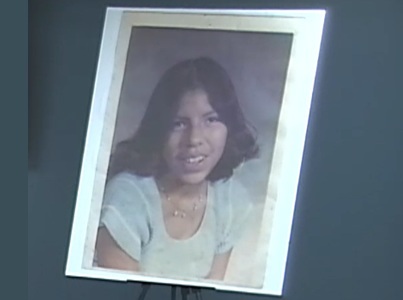
A photo of 16-year-old Corina Contreraz displayed at the press conference announcing the closing of her case. Credit: Yellowstone County Sheriff's Office Cold Case Unit
Investigators in Montana, working with forensic experts, have solved the 1978 homicide of 16-year-old Corina Contreraz by analyzing DNA from an unlikely source: a fingerprint card collected in 1982 upon the suspect’s arrest on unrelated charges.
In fact, the suspect, Angelo J. Stallsmith Sr., was not named in the original investigation. He was not considered a suspect until genetic genealogy led investigators down his family tree.
Case background
On Dec. 22, 1978, a school bus driver discovered Contreraz’s body. She was last seen around 3:00 a.m. leaving a residence. An autopsy that same day revealed Contreraz had been raped and stabbed 18 times.
A rape kit was performed and unknown male DNA was recovered. However, no matches or suspects were found from the biological samples or other physical evidence.
In 2002, evidence recovered in the initial investigation was sent to the Montana State Crime Lab, where a DNA profile was developed. There was still no match in CODIS or any other available law enforcement database.
Two turning points and 44-year-old DNA
The investigation continued with hundreds of interviews being conducted, but no leads were found. Then came the first turning point.
In 2012, Yellowstone County Sheriff's Office formed a cold case unit. The unit selected 9 cases based on solvability—those with physical evidence, DNA and availability of witnesses and persons of interest. One of the selected cases was the homicide of Corina Contreraz.
In 2023, after successfully using genetic genealogy to locate a suspect in one of the other nine cold cases, investigators reached out to Parabon Nanolabs about Contreraz’s case. Analyzing the DNA from the autopsy and using genetic genealogy, Parabon created a list that showed potential leads for the first time ever.
DNA was obtained from a potential relative of the suspect on the list, but results eliminated that specific individual—but confirmed investigators were on the correct brand of the family tree.
In December 2024, investigators narrowed in on two brothers associated with the potential suspect family that both had ties to Billings, where the crime had occurred.
The following month, DNA was obtained from possible relatives across the United States. Weeks later, a DNA sample was obtained from the son of one of the brothers. Genotyping eliminated that brother but again confirmed family lineage.
Now, the investigation was focused on one brother— Angelo J. Stallsmith Sr.—as the prime suspect, but he was deceased and all other avenues for obtaining his DNA sample were exhausted.
Then, Susanne Ryan of Pure Gold Forensics (now the lab director at Borealis Forensics), asked if Stallsmith had ever been arrested. This was the second major turning point in the investigation.
Stallsmith had indeed been arrested. In fact, the Yellowstone County Sheriff's Office documented 19 contacts with law enforcement between 1966 and 1989 throughout the country. He was incarcerated in California, Montana and Oregon. Stallsmith also escaped from San Quentin Prison in California in 1972, before being recaptured days later in Salina, Kansas.
This led Ryan to ask a crazy question: could DNA left on the suspect’s fingerprint booking card could be tested?
In May 2025, both the Billings Police Department and Montana State Crime Lab located and sent booking cards to Pure Gold for analysis. The forensic experts found DNA one the one dated Nov. 11, 1982. They were then able to match it to the unidentified male DNA recovered from the victim’s body in 1978.
Investigators say they believe Yellowstone County is the first law enforcement agency in the country to solve a homicide using DNA recovered from an old fingerprint card. They also said those cards were nearly destroyed as Montana moved to digitize its records.
“To our knowledge, we are the first agency in the United States to be able to get this done. I believe it’s been attempted in the past, but technology is just advanced to the point now that it’s possible and probable,” said Detective Captain Dan Paris of the Yellowstone County Sheriff’s Office during a press conference.
The DNA match was confirmed again when the FBI’s Missing or Murdered Indigenous Persons initiative found and obtained a DNA sample from a direct descendant of Stallsmith. Both Parabon and the Montana State Crime Lab confirmed the match.
Police found no evidence that Stallsmith knew Contreraz. Stallsmith died on Aug. 12, 1990 at Billings Deaconess Hospital.
This is the third cold case the Yellowstone County Sheriff's Office Cold Case Unit has solved since it’s formation in 2012. Prior to Contreraz’s cases, they solved a 1973 double homicide, as well as a 1998 homicide.