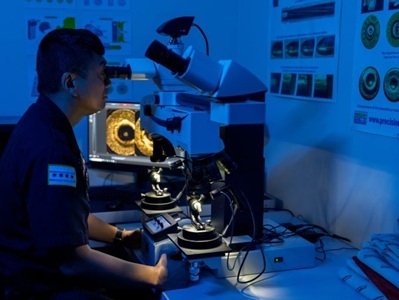
Credit: Chicago Policer Department
National Forensic Science Week, held Sept. 20-26, provides an annual opportunity to recognize the forensic scientists, crime scene investigators, technicians, educators and other professionals whose work helps turn evidence into investigative information.
Across the country, forensic laboratories and law enforcement agencies are marking the week with laboratory tours, educational events, career programs and a look at the technologies and techniques vital to the field. For many members of the public, it’s a learning experience and a chance to have their eyes and ears on something not typically open for public consumption.
The strongest, reoccurring themes in this year's Forensic Science Week recognitions include:
- Forensic laboratories handling enormous volumes of evidence
- Rapid DNA moving closer to routine investigative use
- Ballistic intelligence becoming increasingly localized and rapid
- The workforce pipeline as a major part of the conversation
- Advanced methods are being applied to difficult identification problems
Here’s a look at what several forensic and law enforcement organizations are saying this week.
Texas Department of Public Safety
The Texas Department of Public Safety (DPS) is using National Forensic Science Week to highlight the workload and expanding capabilities of its Crime Laboratory Division.
Over the past year, the division processed 113,259 requests for forensic testing and uploaded a record 148,993 arrestee and offender DNA samples to CODIS.
The division also completed 725 previously unsubmitted sexual assault kits during the year. Texas DPS said 72,549 sexual assault kits are currently being tracked through its statewide Track-Kit system, with 10,603 kits collected in 2026.
Texas is also entering the second year of a Rapid DNA pilot program at booking facilities. The initiative is testing whether DNA samples collected from arrestees can be processed against CODIS in less than two hours, potentially providing investigators with information much sooner than traditional laboratory processing.
The state's crime laboratory system includes 16 accredited labs and programs and approximately 712 personnel.
As part of the week's activities, DPS is also offering public tours at several crime laboratories around the state.
Pennsylvania State Police
Pennsylvania State Police (PSP) is recognizing the scientists, forensic examiners, technicians and support personnel working in its Bureau of Forensic Services, which operates six regional forensic laboratories and a dedicated Forensic DNA Division.
In 2025, it completed more than 35,000 cases while providing forensic services to over 900 law enforcement agencies across Pennsylvania.
The agency is also highlighting the expansion of its Rapid DNA program. Launched statewide in 2025 with 15 automated genetic analyzers, the program was expanded in 2026 to provide municipal law enforcement agencies with access to Rapid DNA capabilities for qualifying, time-sensitive investigations. According to PSP, more than 354 samples have been processed since the initiative began, producing 190 DNA profiles and 163 investigative matches.
Pennsylvania is also expanding its physical laboratory infrastructure. A new PSP forensic laboratory in Greensburg is scheduled to open in early 2027.
Chicago Police Department
The Chicago Police Department (CPD) is marking National Forensic Science Week by recognizing its Forensic Services Division Laboratory, which recently achieved ISO/IEC 17025 accreditation through ANAB. The laboratory includes sections responsible for processing recovered firearms, developing latent prints and conducting latent print examinations.
Chicago's Forensic Firearms Laboratory is also highlighting its role in the National Integrated Ballistic Information Network. According to CPD, the laboratory leads the country among law enforcement agencies in individual pieces of ballistic evidence entered into NIBIN, as well as total NIBIN investigative leads.
Virginia Beach Police Department
The Virginia Beach Police Department is putting the spotlight on the work of its 17-member Forensic Sciences Unit, which includes crime scene and latent fingerprint sections.
The unit has responded to more than 430 cases and collected more than 2,000 items of evidence this year. Its specialists work around the clock on scene documentation, evidence collection and analysis.
NIBIN has become another important part of the unit's work. Since obtaining its own NIBIN terminal in 2021, Virginia Beach Police say they have test-fired about 4,700 firearms, received more than 16,290 cartridge cases and entered more than 6,489 cases into NIBIN. Ballistic evidence that once had to be sent to a state laboratory and could take months to process can now be entered into the system in less than a day.
The unit also handles more than 1,800 fingerprint comparisons each year.
Idaho State Police
Idaho State Police is using National Forensic Science Week to showcase both the breadth of forensic services and the growing role of emerging technology.
The agency's schedule includes educational programming addressing forensic science standards, emerging illicit drug trends, laboratory quality and artificial intelligence in forensic science.
One of the week's featured presentations focuses on the identification of unidentified human remains discovered in Bonner County in 2014. Investigators ultimately combined investigative genetic genealogy, DNA technology, forensic document examination, traditional investigative methods and international collaboration to identify the individual.
The agency is also recognizing forensic professionals through its Rick Groff Visionary Leadership in Forensic Science Award and its Idaho Forensic Science Educator of the Year Award.
Idaho State Police recently broke ground on a new 20,000-square-foot forensic laboratory in Meridian. The facility is scheduled for completion in January 2028.
Washburn University
At Washburn University in Kansas, National Forensic Science Week is providing students with a direct connection to forensic practitioners and potential employers.
The university's forensic science programs partnered with the Kansas Bureau of Investigation (KBI) for a Sept. 22 roundtable involving scientists and experts from the KBI Forensic Science Center, Jackson County Medical Examiner's Office, Johnson County Crime Lab and Topeka Police Department.
Students were able to explore forensic biology, chemistry, digital forensics, anthropology and forensic investigation, along with employment and internship opportunities.
Washburn's forensic science programs are supported by a crime laboratory operated in partnership with the KBI on the university campus.
The people behind the evidence
Taken together, this year's National Forensic Science Week activities illustrate how broad the forensic profession has become.
Laboratories continue to process enormous volumes of evidence while maintaining accreditation and quality standards. Law enforcement agencies are bringing technologies such as Rapid DNA and NIBIN closer to the point of investigation. Specialized disciplines continue to expand the range of evidence investigators can examine, while universities and laboratories work to attract and train the next generation of forensic professionals.
Forensic science may often operate behind the scenes, but the work remains closely connected to investigations, identification, prosecution and the pursuit of answers for victims and their families. National Forensic Science Week offers an opportunity to bring that work into view—and to recognize the professionals responsible for doing it.
Did your agency give a shoutout to you and your hardworking forensic colleagues? If so, please share it in the comments below!