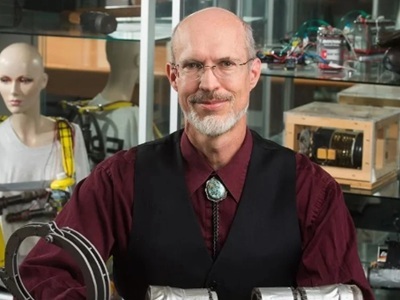
Kirk Yeager, FBI senior forensic examiner, explosives, will return to URI on Nov. 20 to present a lecture as part of the University’s Forensic Science Partnership lecture series. Credit: Kirk Yeager via URI
The University of Rhode Island’s Forensic Science Partnership lecture series is once again back on the crime beat, with several legal and forensic experts slated to visit the Kingston Campus every Friday afternoon this fall.
In recent years, one of Rhode Island’s more unique seminar series has brought international and local authorities to talk about everything from cold cases to terrorist bombing incidents to the infamous 1990 Isabella Stewart Gardner Museum heist. Visiting speakers have come from the Rhode Island State Fire Marshal Office, the Rhode Island Department of Health, Providence Police Department, Boston Fire Department, the U.S. Department of Homeland Security, the FBI, and other law enforcement agencies and institutions.
All lectures are free and open to the public, and held on Fridays at 3:30 p.m. in Room 100 in the Richard E. Beaupre Center for Chemical and Forensic Sciences, 140 Flagg Road, Kingston.
This fall’s remaining speakers and topics are:
Sept. 18: “CSI @ URI,” Dennis Hilliard, M.S. ’80, Rhode Island State Crime Laboratory director. Hilliard’s work includes analysis of evidence and court testimony in the areas of fire debris analysis, hair and fiber analysis, DNA analysis, and breath and blood alcohol analysis.
Sept. 25: “Crime Scene Investigation: Every scene every time, striving to ensure justice,” James Clift, Warwick Police Bureau of Criminal Identification. Clift recently retired as a detective for the Providence Police, the largest police department in Rhode Island, and is now a criminalist with the Warwick Police Department.
Oct. 2: “Drug Analysis,” Alexis Donaway, Rhode Island Department of Health forensic scientists. Donaway has spoken at URI previously about the use of toxicology to aid investigations.
Oct. 9: “Shooting Straight: The Basics of Firearm and Toolmark Examinations,” Alec Wyers, Rhode Island State Crime Laboratory criminalist I: firearms and toolmark examiner. Wyers, who works as a firearm and toolmark examiner, presented a talk at the University last year.
Oct. 16: “How a Toxicologist Uses Science to Shape Policy and Save Lives,” Sabra Jones, National Highway Traffic Safety Administration Northeast regional toxicology liaison. Jones conducts research in the areas of forensic toxicology, analytical chemistry, and impairment.
Oct. 23: “Forensic Photography,” Mark Zabinski, Rhode Island State Crime Laboratory criminalist II latent print examiner. The former Cranston, Rhode Island, police detective and crime scene investigator is a specialist in friction ridge identification (more commonly known as fingerprinting). He is a certified latent print examiner by the International Association for Identification.
Oct. 30: “Crime Doesn’t Pay, but Forensic Investigations Do,” Sujit Purushothaman, FM senior lead research engineer. Purushothaman specializes in electromagnetic field analysis of rotating machines, thermal modeling and analysis of transformers and cables, and finite element-based simulations and analysis.
Nov. 6: “Branches, Bloodlines and Breakthroughs: DNA, Genealogy and the Future of Forensics,” Kelly Cormier, Cold Case Coalition. Cormier has helped solve approximately 70 unknown/unexpected parentage cases by leveraging autosomal DNA test results in coordination with traditional genealogical research.
Nov. 13: “Catching the Bad Guy,” Brian Andrews, Rhode Island State Police detective (retired). Andrews led the State Police’s detective division during the height of New England’s drug and mob wars in the 1970s and 1980s.
Nov. 20: “Whatever happened to Ragnar?,” Kirk Yeager, senior forensic examiner, explosives, Federal Bureau of Investigation. Yeager analyzed the 2013 Boston Marathon bombing, as well as a number of other high-profile cases, including the 1993 World Trade Center bombing, 1995 Oklahoma City bombing, 2016 Brussels bombing, and 2002 Bali nightclub bombings.
Dec. 4: “Toxic Chemicals,” Gregory Emerson, Rhode Island Department of Health forensic scientist. Emerson will discuss how analyzing such chemicals is important to certain criminal investigations.
Dec. 11: “Forensic Science and Expert Witness Testimony,” Gil Sapir, a forensic science consultant and attorney in Chicago. He earned a bachelor’s degree in microbiology and biology from Colorado State University, his law degree from IIT/Chicago-Kent College of Law, and a master’s degree in criminalistics from the University of Illinois-Chicago.
The public can park in Lot 13 behind the Beaupre Center, which is open for general parking at 3 p.m. on seminar Fridays. High school students interested in forensics are also welcome. Those who cannot attend in person may view the lectures live online.
Previous lectures can also be viewed online.
Republished courtesy of URI