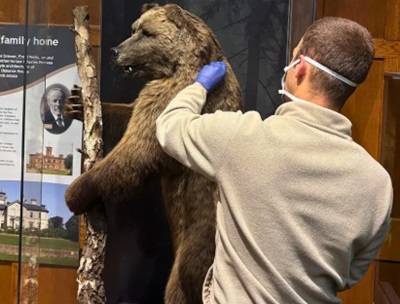
Student researcher Hayden Leigh collecting hair samples from Boris the Bear. Credit: Museum of Chelmsford
A University of Staffordshire student is using hair from a 120-year-old taxidermy bear to explore new ways of preventing wildlife crime.
"Boris the Bear" has been a popular exhibit at the Museum of Chelmsford since 1932—so much so that he’s considered to be the museum’s unofficial mascot.
Now, Boris could help protect modern-day Brown Bears from illegal poaching thanks to a research project by Forensic Science student Hayden Leigh.
Leigh is investigating how Brown Bear hair varies under a microscope and how these characteristics could improve the identification of animal hairs during wildlife crime investigations.
By developing more a cost-effective and reliable alternative to DNA analysis, the research aims to help tackle the illegal poaching and trafficking of wildlife.
Leigh contacted the Museum of Chelmsford to request a sample of Boris’s hair to support his work and, after careful consideration of Boris’s condition, staff agreed to grant Hayden access to retrieve a few hairs for forensic analysis.
“Taxidermy samples from museums can play a valuable role in the research of animal hair within a forensic context, as they are often far more accessible than obtaining hair from live animals. In my project, I examined Boris’s hair at a microscopic level, assessing the characteristics of the hairs and investigating whether there was any variation across different areas of the body," said Leigh. “Having access to a preserved specimen, like Boris, provided an opportunity to examine authentic animal hair in a controlled and ethical way, without the need to handle or disturb a live animal. Taxidermy collections such as this therefore offer a wide range of opportunities for scientific investigation, providing researchers with valuable biological material while also preserving the animal itself. This means that individual specimens can continue to contribute to research and provide opportunities for further study long after they have entered a museum collection.”
“Taxidermy is often considered a controversial part of museum collections. Today we condemn wildlife trafficking and poaching for sport, and some of the species found in museums across the world are now considered endangered or extinct due to excessive hunting. But how wonderful it is that historic taxidermy specimens like Boris could now help protect future animals from illegal hunting. It highlights the scientific value of historic taxidermy collections in museums in 2026, and we are delighted that the Museum of Chelmsford has been able to support this important project," said Councillor Jennie Lardge, Cabinet Member for Culture and Leisure at Chelmsford City Council.
Leigh graduated this summer with first class honours and is now staying at University of Staffordshire to begin a PhD, continuing his research into Brown Bear hair morphology and its potential applications.
Republished courtesy of University of Straffordshire