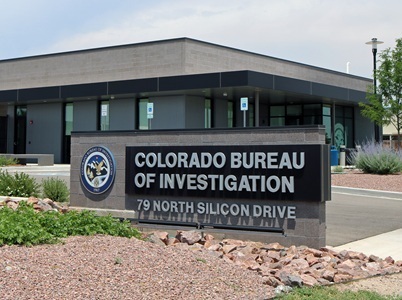
The Colorado Bureau of Investigation (CBI) office at 79 North Silicon Drive in Pueblo West, Colorado. Credit: Jeffrey Beall, July 2017
On Tuesday, former Colorado Bureau of Investigation (CBI) forensic analyst Yvonne “Missy” Woods was sentenced to 10 years in prison, closing a yearslong chapter in one of the biggest DNA scandals in decades—although the fallout is far from over.
In June, Woods pleaded guilty to four felonies—cybercrime, perjury, forgery and attempting to influence a public servant. In exchange, prosecutors dropped the remaining 100 charges against her. Under Colorado’s sentencing guidelines, Woods faced between eight and 16 years in prison.
“Woods’ actions were criminal and she was held accountable for her misconduct. It was a violation of the law and a betrayal of the scientific standards and professional values that define the CBI and its forensic laboratories,” said the CBI in a statement. “CBI has taken aggressive action to reform our laboratories to strengthen public trust and ensure that victims, the public safety community, and the state can be confident in the results produced by our hardworking staff.”
In Sept. 2023, CBI became aware that DNA sample testing performed by Woods, a 29-year veteran of the CBI crime lab, may have deviated from standard operating procedures. On Oct. 3, 2023, Woods was placed on administrative leave, and an internal investigation was initiated by then-CBI Director Chris Schaefer. Woods performed no additional laboratory work and retired on Nov. 6, 2023.
Following the discovery of Woods’ actions, CBI launched a review. Aided by the Kansas Bureau of Investigation at times, CBI ultimately identified 1,003 cases impacted by Woods’ misconduct in her nearly 30-year career. This number was announced in December 2024, and included nearly 200 more cases than the 809 originally identified in a June 2024 report.
The findings show Woods omitted material facts in official criminal justice records and tampered with DNA testing by altering or omitting some test results from the case file. For example, Woods deleted data showing that male DNA was present in swabs from sexual assault kits administered on female victims. However, the report says Woods did not falsify DNA matches. By deleting the data, Woods could quickly close the case without testing for male DNA profiles.
Ultimately, the report showed Woods deviated from standard testing protocols and cut corners—which put all of her work, starting in 1994, into question.
Darren Kafka, senior deputy district attorney for the First Judicial District Attorney’s Office told The Colorado Sun that the investigation into Woods’ prior cases found 52 lab reports where she said something “categorically untrue” and 53 where her statements were technically truthful “but seemed calculated to influence a police detective not to act on the results.”
Only 12 cases resulted in formal charges being filed and only three of those went to trial. Two of those cases, both sexual assaults, resulted in acquittals despite Woods’ claims. The other is the case of Ryan Hicks, a man found guilty of first-degree murder in 2014. Tuesday’s sentencing comes as Hicks’ lawyer seeks to overturn his conviction, arguing that Woods’ false testimony contributed to his conviction. The one perjury charge against Woods was tied to Hicks’ case.
Even so, Woods’ pattern of data manipulation denied victims justice. For example, Kafka said a single edit she made in one case called 27 other cases into question—including 13 sexual assaults, five involving children, and two homicides.
“This sentencing does not change the impact of what occurred, but it does mark another step forward,” said CBI Director Armando Saldate. “The actions of one individual never define this organization, and they do not define the dedicated public servants who continued showing up every day with integrity. I am proud of the ways the CBI has improved and reformed our laboratories to ensure that victims in Colorado get answers.”
The reform “started” in July 2025 after Forward Resolutions conducted an assessment and report that found past deficiencies, especially with CBI Forensic Servieces operations and leadership from 2022-2024, with some historical review extending back to 2010.
Specifically, the report contains 52 recommendations meant to be implemented over a period of 5 to 10 years. The most significant recommendation is one other labs have been seeing as well—establishing the lab as a standalone division outside of law enforcement.
CBI is set to begin implementing the other recommendations through a phased schedule that includes three 18-month-long phases over the next 5 years. The agency is prioritizing those that can be implemented with existing resources, and will work with the legislature to secure the funding and input required for future phases. A few of these recommendations include:
- Quality assurance: CBIFS implemented 20 procedural changes prior to the release of the report, and is in the process of implementing 21 more focusing on strengthening standards for submitted evidence, increasing transparency around quality incidents and updating key laboratory instruments and technology. This also includes hiring four additional firearms examiners and seven additional DNA analysts.
- Communications: CBIFS will establish a symposium for stakeholders to provide regular updates to law enforcement, prosecutors, defense attorneys, and judges to increase accountability, transparency, and collaboration. There will also be ongoing communications around improvements to the CBIFS Quality Assurance Program enhancements and continuing impacts of the Woods Quality Investigation.
- Organizational culture and leadership development: Implementation of a values-driven leadership training course for the CBIFS management. Clarifying performance expectations, roles and responsibilities, and internal communications, with a focus on workplace wellbeing and healthy team dynamics.