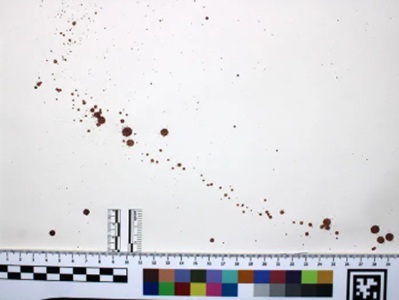
A bloodstain example created for the research using ethically sourced horse blood. Credit: University of Staffordshire
Emma Hook has been awarded the Science & Justice Review Award by the Chartered Society of Forensic Sciences for the best review paper published in the peer-reviewed journal Science & Justice during 2024–2025.
The award, chosen by the journal's Editor-in-Chief and the Society's Council, recognizes Hook’s paper, Bloodstain Classification Methods: A Critical Review and a Look to the Future, co-authored with University of Staffordshire academics Sarah Fieldhouse and David Flatman-Fairs, alongside Professor Graham Williams from the University of Hull.
The study is part of Hook’s ongoing PhD research, which could help to establish the first internationally standardized approach to bloodstain pattern analysis.
Bloodstain pattern analysis (BPA) plays a crucial role in forensic investigations, helping scientists reconstruct violent incidents by examining the size, shape and distribution of bloodstains at crime scenes. Yet despite more than 60 years of research and operational use, there is currently no nationally or internationally agreed method for classifying bloodstain patterns.
Having already gained undergraduate and master's degrees in Forensic Science, Hook’s interest in BPA began after completing a short professional training course.
“When I completed my master's degree, I was taught bloodstain pattern analysis one way. Then I attended a training course and was taught a different way,” Hook said. “I came away asking myself, 'Why isn't it all the same?' Other forensic disciplines, such as DNA analysis and fingerprint examination, have standardized methods. So why doesn’t bloodstain pattern analysis have one too? You never get exactly the same bloodstain pattern twice, but that doesn't mean we can't have a standardized way to describe, classify and communicate those patterns.”
Hook’s paper identifies that there are at least 10 BPA classification methods with significant differences in how bloodstains are categorized, highlighting the need for a more objective, evidence-based approach.
A key finding is that many current methods rely on mechanistic terminology—terms that imply how a bloodstain was created, such as "impact spatter" or "wipe"—rather than simply describing what can be observed. Emma’s research argues this can encourage subjective interpretation and increase the risk of contextual bias.
Instead, the paper calls for a validated, standardized classification methodology based on directly observable characteristics, enabling analysts to make more transparent, repeatable and scientifically robust decisions.
“If we're all using different methods with different terminology, it becomes much harder for forensic scientists to have clear, professional conversations. A standardized approach would improve objectivity and consistency while strengthening confidence in forensic evidence,” said Hook.
After working as a secondary school science teacher and later as a college lecturer, Hook is now a lecturer at the University of Derby alongside completing her PhD with University of Staffordshire’s Centre for Crime, Justice and Security.
Hook’s research is now building on the award-winning paper by investigating which classification methods forensic practitioners actually use, why they favor particular approaches, and what they believe a future standardized system should include. She is also testing different classification methods with analysts to measure their accuracy, repeatability and reproducibility.
Republished courtesy of University of Staffordshire