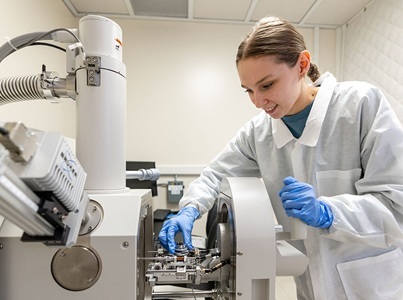
UW-Platteville forensic investigation program earns FEPAC accreditation. Credit: UW-Platteville
The University of Wisconsin-Platteville announced that its Department of Criminal Justice and Forensic Investigation has earned accreditation from the Forensic Science Education Programs Accreditation Commission (FEPAC), a body of the American Academy of Forensic Sciences (AAFS). The accreditation covers all three emphases of the Forensic Investigation major: Crime Scene Investigation, Medicolegal Death Investigation and Laboratory. UW-Platteville is among a very small number of forensic science programs nationwide to hold this accreditation.
This recognition also places UW-Platteville among just 32 bachelor’s degree programs in the country to hold FEPAC accreditation. Five of those programs are accredited in Crime Scene Investigation. UW-Platteville is the only university in the Upper Midwest with that distinction. UW-Platteville is also the only program in the country with an accredited Medicolegal Death Investigation emphasis. This accreditation reflects the depth, breadth and exceptional quality of the forensic science education offered through UW-Platteville.
That broader standing is reflected in the program’s long-term development, says Travis Nelson, Dean of the College of Liberal Arts and Education at UW-Platteville. “FEPAC accreditation is an important distinction for a program like ours,” Nelson said. “This reflects the work that faculty and staff in the Department of Criminal Justice and Forensic Investigation have done over many years to align with best practices and prepare students for work in the field.”
For students, that work takes shape through training designed for several forensic career paths including law enforcement, crime laboratory science, crime scene investigation, lab work and death investigation. The Department of Criminal Justice and Forensic Investigation does so through academic training across its three accredited emphases. A key part of the program is the Forensic Investigation Crime Scene House (FICSH), a house built for the program by UW-Platteville Construction Management majors in 2010. The FICSH is used to simulate crime scenes and extend learning beyond the classroom.
That hands-on setting is complemented by a nearby taphonomic (decomposition) research area. It expands the program’s ability to provide forensic training in applied settings. Together, these facilities support student preparation for work in forensic science.
Data from UW-Platteville