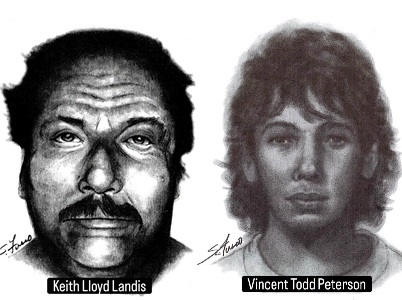
Credit: Orlando Police Department
After decades of unanswered questions, detectives with the Orlando Police Department’s Cold Case Unit have identified two men whose deaths had remained unresolved since 1982 and 1996.
1982 case
In June 1982, an unidentified male was found deceased at the bottom of an elevator shaft inside the Atlantic Bank building, which was under construction at 20 N. Orange Avenue in Orlando, Florida. A construction worker had entered the building to retrieve equipment when he made the discovery and notified law enforcement. The Orlando Police Department responded and began collecting evidence and investigating. Investigators determined the man was a white male who could not be identified. Officials later stated there were no apparent signs of foul play, and the cause of death was listed as undetermined.
Investigators determined that the man was stopped by police in October 1981 and June 1982. At the time, the man identified himself as Adam Kadmon, claimed to be homeless, and told police he recently moved to Orlando from Melbourne Beach, Florida.
Despite a lengthy investigation, the man could not be identified and became known as Elevator Shaft John Doe. Details of the case were entered into the National Missing and Unidentified Persons System (NamUs) as UP612.
In 2023, detectives with the Orlando Police Department Cold Case Unit, working with the Districts 9 and 25 Medical Examiners Office, submitted evidence to Othram. Scientists worked to develop a DNA extract from the provided remains, then used Forensic-Grade Genome Sequencing to build a comprehensive DNA profile for the man. Othram's forensic genetic genealogy team used the profile in a genetic genealogy search to develop new investigative leads that were returned to law enforcement.
Using this new information, a follow-up investigation was conducted leading investigators to potential relatives of the man. Reference DNA samples were collected from potential relatives and compared to the DNA profile of the unknown man using KinSNP Rapid Relationship Testing. This investigation led to the positive identification of the man, who is now known to be Vincent Todd Peterson. Peterson's family made many attempts to locate him after losing touch with him.
1996 case
On Sept. 15, 1996, witnesses discovered a man lying face down in a field between two apartment complexes in Orlando, Florida. Authorities found no signs of trauma and determined he died of natural causes.
His DNA was sent to Othram, who tested it and traced it to the Landis family. The John Doe was then identified as 49-year-old Keith Lloyd Landis, whose identity was confirmed through DNA comparison with his sister. The sister said she had not heard from Landis since the mid-1990s.
These identifications mark a significant breakthrough in both cases and highlight the Cold Case Unit’s commitment to using advances in forensic science and DNA technology to identify the unknown and bring long-awaited closure to families.
Data from Orlando Police Department and Othram