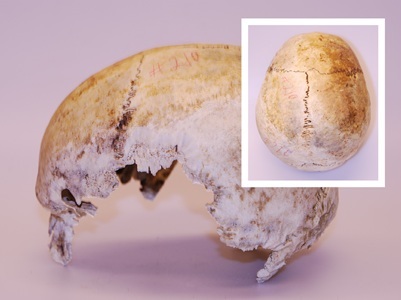
The skull as found in North Bay in 1975. Credit: North Bay Police
Investigators in Ontario have used investigative genetic genealogy to give a man—a WWI veteran—his name back after parts of his skull were found in a swamp area off a highway in 1975. Claude Hamilton Brownscombe is now identified after being a John Doe for the past 51 years.
At the crime scene in 1975, officers conducted an extensive search of the area but were unable to locate any additional human remains or evidence beyond partial parts of the skull.
The skull was then submitted to the Centre of Forensic Sciences in Toronto for examination to confirm it was human and provide an estimate of the individual's age. Based on forensic analysis and information available at the time, the anthropologist's report estimated the individual to be between 25 and 70 years of age, and deceased for approximately one to two years before the remains were discovered.
Over the following years, the investigation was periodically reviewed. However, without additional investigative leads, investigators were unable to determine the individual's identity and the investigation became inactive.
Identification timeline
In 2006, DNA testing was attempted; however, a usable DNA profile could not be develolped.
In 2012, further DNA testing was conducted, and the resulting DNA profile was compared against three local missing persons cases. No match was identified, and the DNA sample was not suitable for comparison through available databases.
In 2023, investigators revisited the case, recognizing that advancements in forensic science—particularly investigative genetic genealogy—had created new opportunities. These advancements allowed investigators to use the existing DNA sample and generate new investigative leads to move the investigation forward.
At this time, North Bay Police also determined foul play was not suspected.
Building out the family tree
The family tree ultimately led to a married couple who became the focus of the case. The couple's family history was reviewed, and North Bay Police were able to account for the deaths and burial locations of all their children—except one son named Claude Hamilton Brownscombe.
Historical records provided important insight into the son's life.
Military medical records from the First World War placed Brownscombe in Toronto in 1917 at 22 years of age, and described him as 5 feet 2 inches tall with blue eyes and brown hair. The records also indicated he was medically fit for the Canadian Overseas Expeditionary Force. (Although dental records were available, police were unable to compare them because the jaw was not recovered with the skull.)
Newspaper articles from the Porcupine Advance showed Brownscombe was living in Timmins as early as 1928. He worked at the McIntyre Mine and participated in community activities, including a local bowling league.
After 1950, when the newspaper ceased publication, records on Brownscombe became scarce, according to the authorities. While he was found on voters' lists in 1949 and 1957, police did not find any records confirming his death. The last public record of Brownscombe is from 1959.
Building a family tree from the DNA sample and historical records, investigators were eventually able to locate and interview two surviving family members. A great-nephew recalled seeing Brownscombe around 1953 and described him as living a quiet, private life in a cabin somewhere in Northern Ontario. This information is consistent with the location and circumstances in which the human remains were discovered in 1975.
The great-nephew and great-niece provided DNA samples that confirm the human remains discovered in North Bay in 1975 belong to Claude Hamilton Brownscombe, who was born on Oct. 24, 1896, in Axbridge, Ontario.
“I think for anyone finding out that a loved one had been lying unidentified for so long, it brings a large measure of comfort just to know who he is. And in this case, he's also a veteran of the First World War, which makes it even more important that he gets his name—and his dignity—back,” said Detective Constable Mike Kelly of the Toronto Police Service Homicide and Missing Persons Unit.
Kelly was involved with the investigation as a representative of the Toronto Police Service, which has a full-time, in-house genetic genealogy team funded through a grant from the Office of the Solicitor General of Ontario. Part of that grant commits the Toronto Police to assisting all partner agencies—like North Bay—across the province, giving every police service in Ontario access to the program.
“We're always reaching out to colleagues, asking whether they have cases involving unidentified remains or historical homicides,” said Kelly. “It's just a matter of time, ideally, before we're able to solve each of these cases. I'd recommend that family members consider uploading their own private DNA kits to some of the websites, which could assist with IGG in the future.”