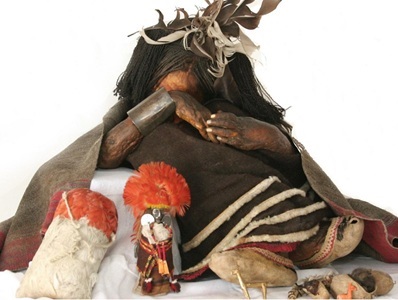
The Boy of Cerro El Plomo and his funerary assemblage. Credit: National Museum of Natural History of Chile.
A new forensic reexamination of three children and adolescents sacrificed in Inca Capacocha rituals is challenging earlier interpretations about how the individuals died.
The study, published in Science Advances, examined two females from Cerro Esmeralda in northern Chile, as well as an 8-year-old male—Niño de El Plomo from Cerro El Plomo, who was discovered in 1954 at 5,400 meters in the high Andes of central Chile by treasure hunters.
These new results provide no support for earlier hypotheses that the two Cerro Esmeralda individuals were strangled. Additionally, since discovery, Niño de El Plomo death had largely been attributed to hypothermia during a high-altitude Inca ceremony. However, new forensic analyses identified evidence consistent with cranial trauma sustained in the context of a Capacocha ritual sacrifice.
Capacocha was one of the most important ceremonies of the Tawantinsuyu, the Quechua name for the Inca Empire. During these ceremonies, children and young women were selected to be offered to the sacred mountains, or apus, as part of a process that intertwined sacrifice, pilgrimage, political power, religion and imperial expansion.
A suspected strangulation no more
The Cerro Esmeralda individuals were a 9-year-old girl and 18-year-old woman. Their remains were discovered in 1976 after the tomb was partially destroyed with dynamite.
Earlier interpretations had identified linear impressions on the necks as possible ligature marks, raising the idea of strangulation. The new computed tomography (CT) examination, however, found “no fractures, displacement or other cervical trauma involving the hyoid bones.”
The researchers concluded that the superficial linear impressions were more consistent with compression from textiles or clothing than with ligature marks. The findings therefore do not support strangulation as the cause of death for either female individual.
The study authors noted this as a recurring challenge in forensic examination of juvenile remains: the absence of a hyoid fracture cannot by itself exclude strangulation, particularly because the bone is more elastic in children and adolescents.
In this case, the overall imaging findings did not provide corroborating evidence of a fatal neck-compression event.
New evidence in death of Niño de El Plomo
Niño de El Plomo presented a different forensic picture. Earlier interpretations had attributed the child's death to hypothermia, partly because of presumed cold-induced damage to the fingers and the apparent absence of traumatic injury.
The new examination, however, found no evidence of antemortem freezing or cold-induced tissue damage in the extremities. Histological examination showed no inflammation or tissue degeneration, while the preserved plantar skin displayed features consistent with sustained frictional loading.
According to the study results, CT imaging identified an oval lesion on the left frontal region of the skull, measuring approximately 36.6 by 20.5 millimeters. Beneath the lesion, researchers identified a linear perimortem fracture of the left frontal bone. The injury was accompanied by extensive traumatic separation along the coronal and sagittal sutures.
The spatial correspondence between the external lesion and the underlying fracture indicated a single impact focus. The researchers interpreted that pattern as “consistent with a closed blunt-force injury.”
To assess whether blunt-force trauma could have generated the injury, the researchers created a CT-derived finite element model of the child's left hemicranium. Among the weapons evaluated, a blunt-lobed, lithic, star-shaped mace head produced the closest match to the recorded lesion footprint.
The researchers then modeled the impact mechanics associated with that area. The simulations indicated that a force of 2,800 newtons produced deformation of 2.44 millimeters, closely matching the measured cranial thickness at the impact site.
The researchers say the results support the biomechanical plausibility that a high-energy blunt impact could have produced the fatal cranial lesion and associated suture separation.
New radiocarbon dates
Lastly, new radiocarbon dates place the three individuals broadly within the same period. The median calibrated dates are approximately CE 1440 for the 9-year-old girl, CE 1450 for the 18-year-old woman, and CE 1480 for the Niño de El Plomo.
The researchers place these sacrifices within the expansion of the Inca state into the southern Andes. In the Capacocha ritual, selected individuals were brought from their communities to Cuzco and then taken on pilgrimage to remote sacred sites, including high mountain summits.
Isotopic analysis of the hair of all three victims showed evidence of changing dietary and mobility patterns during the individuals' final periods of life. The broader interpretation here is that the ritual was not an isolated act of sacrifice, but part of a wider political and/or religious system.
The researchers say the most significant conclusion is that earlier interpretations should be revisited when new technologies allow—just as today’s modern technology is being applied to homicide cold cases from 10 to 50+ years ago.
“This study enabled us to re-examine exceptionally important heritage contexts applying new research questions, new technologies and ethical conservation criteria,” said says Verónica Silva Pinto, first author of the paper and instructor at University of Valencia (Spain). “In the case of the Boy of Cerro El Plomo, the evidence prompted us to reassess an interpretation that had been accepted for decades and to propose a different explanation for the circumstances surrounding his death.”