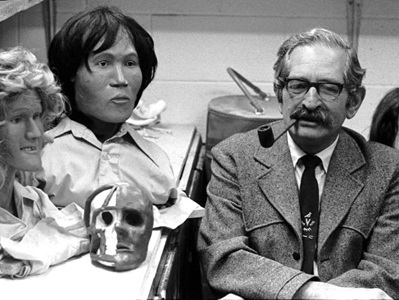
Michael Charney, a CSU forensic anthropologist, is shown in his laboratory at Colorado State University, where he worked on forensic facial reconstruction to aid with identification of human remains. He led identification of victims of the Big Thompson Flood, which occurred west of Loveland on July 31, 1976, and in that way contributed to the history of Colorado. Credit: CSU Libraries, Archives & Special Collections
With the approach of the 50th anniversary of the Big Thompson Flood near Loveland, Colorado State University is remembering the role of the late forensic anthropologist Michael Charney, who led the successful identification of 139 recovered bodies – and, in the process, helped advance the field of disaster victim identification.
At the time, Charney was an anthropology faculty member at CSU and deputy coroner for Larimer County. As a physical anthropologist with expertise in human skeletal remains, he was quickly called to help identify flood victims. Through his response, he left his mark on Colorado history.
Charney worked with a forensic pathologist, who conducted autopsies to determine cause and manner of death, and a forensic odontologist, a specialized dentist who could compare physical remains to dental records. He would later urge law-enforcement and other agencies nationwide to improve and standardize victim identification using such scientific teams. He also advocated for policies that clearly outlined distinct roles and responsibilities in disaster victim identification.
It took Charney and his team more than two months to identify the flood victims. “It was an amazing contribution to the community,” said Jason LaBelle, an archaeologist in CSU’s Department of Anthropology and Geography. The department offers a minor in forensic anthropology.
“The flood was such a catastrophic event, and the casualties were so high that it propelled him into public awareness,” said LaBelle, who earned his bachelor’s degree in anthropology at CSU and took classes with Charney.
The disaster began the night of July 31, 1976, when a violent thunderstorm stalled over the Big Thompson Canyon west of Loveland, Colorado, producing a wall of water that raged down the dark canyon. It was Colorado’s statehood centennial, which had drawn hundreds of tourists and campers to the picturesque canyon leading from Loveland to Estes Park; many could not escape the flash flood.
As floodwaters subsided, body recovery began – as did an identification challenge that none of the responders had ever confronted. Many victims were unrecognizable, preventing straightforward identification.
Charney and his colleagues forbade families from viewing the mass of collected corpses in an effort to identify loved ones. “These people have gone through enough trauma,” he told former CSU history Professor David McComb in an interview a month after the flood, as identification efforts were still underway.
That added to the pressure of making positive identifications by matching physical features, fingerprints, dental records and other distinctive characteristics, he explained. Charney also used a portable X-ray machine, now housed at the Loveland Museum, that allowed him to identify victims through, for instance, the healed fracture of a broken leg, a surgical hip replacement and the embedded BBs from an air-rifle accident. In some cases, he relied on his knowledge of bones and bone fragments to determine age, sex, ancestry and height.
“We don’t want to make mistakes because you’re dealing with people with extreme emotions,” he said in the oral history interview, held by the CSU Libraries. “I see my job as a scientific expert who can identify bodies with certainty and tell somebody, this is your husband, this is your brother, this is your uncle, your sister. I’m bringing to this work everything I’ve ever learned about this, and I’ve got to do as good a job as possible.”
When the flood occurred, Charney was 65 years old and had four decades of experience identifying human remains for law enforcement and other agencies, including the Texas Rangers. But he had never responded to a disaster with mass casualties.
Yet he and his colleagues soon consulted with public agencies across the country to explain the responsibilities and logistics they undertook so that others could use the practices in times of tragedy.
To further that work, Charney – in his role as a professor emeritus – established the Center for Human Identification at CSU in 1979. The university later closed the center as it emphasized other disciplines in anthropology.
Through the center, Charney consulted on many cases, conducted research related to body identification, and taught students skills including forensic facial reconstruction to aid with identification. Through the center, he also pushed for change, such as improved practices used by the U.S. Army Quartermaster Corps Laboratory to identify servicemen killed in the Vietnam War.
As a teacher, Charney helped CSU students understand the estimations they could glean from the study of skeletons, said Diane France, a board-certified forensic anthropologist with a private laboratory in Fort Collins. She earned bachelor’s and master’s degrees from CSU and assisted Charney in his campus laboratory before going on to earn a doctorate.
Charney’s laboratory was in a campus building called the Potting Shed off Laurel Street. People knew “the doctor was in” when they saw his parked white Porsche convertible with rusting side panels, according to a remembrance from Northern Colorado History.
In 1998, Charney died at the age of 86 at the Veterans Administration Hospital in Denver from complications of asthma.
Republished courtesy of Colorado State University